The city of Brewster has an apple history that is seemingly intertwined, and yet also equally distinct, from the nearby cities of Pateros (6 miles to the ~southwest) and Bridgeport (10 miles to the ~southeast). Brewster rests at the convergence of the Okanogan River and Columbia River and is the gateway to the Okanogan Valley to the northeast – just like Pateros is the gateway to the Methow Valley to the northwest. It should then come as no surprise that in the 1960s (if not earlier), Brewster was using this image on letterhead, referring to “The Key City” with clear reference to the apple, cattle, and lumber industries which made Brewster what it is today. This section, just like for Pateros, the Methow Valley, and Bridgeport, attempts to trace apple growers and their histories for over the past 100 years.

Braker & Custom Apple Packers
On New Year’s Day, January 1, 1926, the Brewster Herald published an article titled, “From Ten Acres of Undeveloped Land to Fifty Five Producing,” describing the success of the George and Nell (Cowles) Braker orchards on the Bridgeport Bar. The Braker’s were included in this special edition because the paper, on that day, focused their reporting on the early pioneers and homesteaders to the Brewster-Bridgeport region – the Braker’s being a prominent and well-known family.
George and Nell arrived in Washington from Wisconsin in 1909. As Nell remembered in an interview from 1979 (Quad City Herald, August 9, 1979), her and George were married one week, and left for Washington the next. She was 19 years old at the time.
When they arrived in Washington by train, they stopped first in Wenatchee, then took a steamboat to Bridgeport. Nell stayed in a hotel while George began building a “tiny house” on ten acres of land which he had purchased on a previous trip from “Mr. Crewdson” from Chicago (this is the same Mr. Crewdson who played such a major role in orchard developments across the Bridgeport Bar and is discussed in more details in the “Bridgeport Growers” section). Nell was quoted as saying the tiny house was “a shack, really”, but this was only a temporary home.
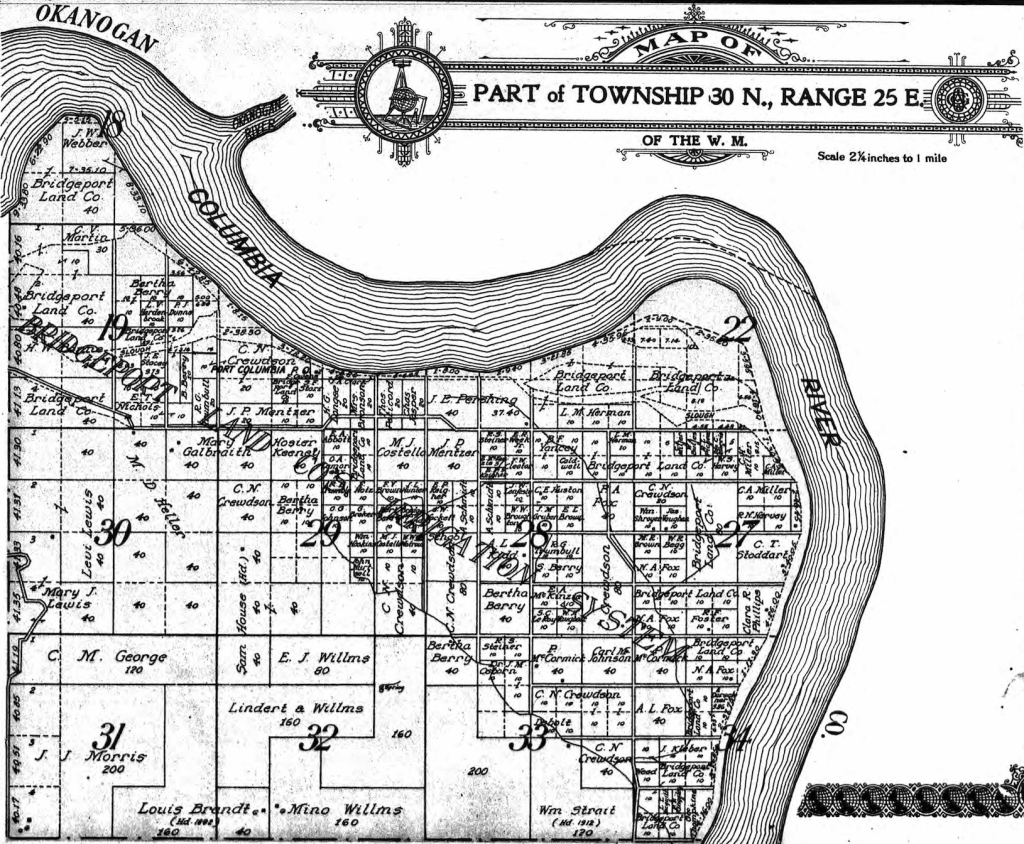
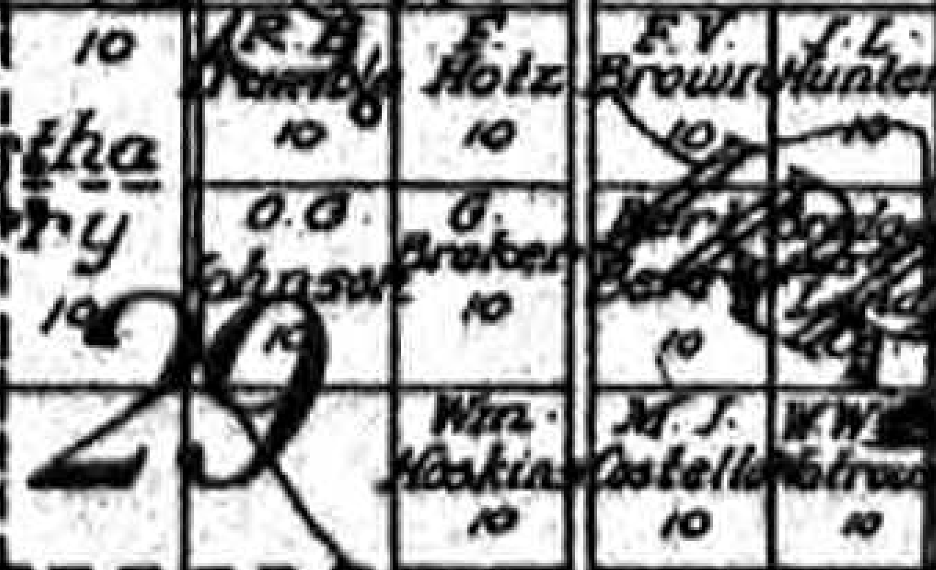
Within the decade between ~1910 and 1920, George and Nell expanded their orchard operation, built a larger home, and eventually built their own packing shed on the Bridgeport Bar. During this time of growth and expansion they worked for Crewdson, Outcoult, and the “Buster Brown” Orchards. George and Nell also had two children during this time, a daughter, Thelma (Braker) Barth (born in November 1909), and a son, Sidney (or Sid) Braker (born in October 1912).
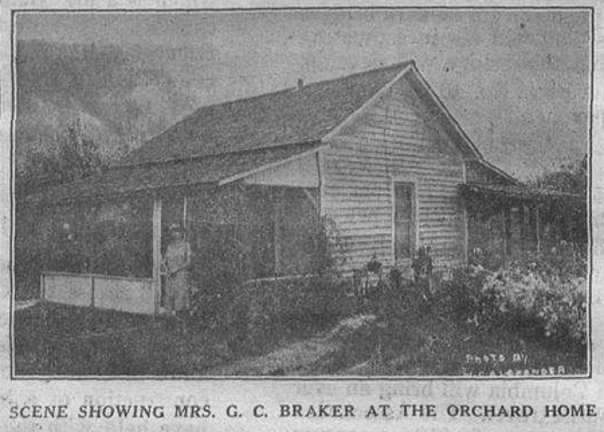
In the 1926 Brewster Herald retrospective, the article noted that the Braker’s finished their packing shed in 1920, and in 1926 their family expected to produce 30,000 boxes of Delicious apples from 55 acres of orchard. At that time, they estimated the cost of irrigating their orchard at $11 per acre for a season (approximately $208 in 2026), all coming from a concrete lined well they dug and constructed at the orchard. The paper concluded their article with praise for the Braker’s entrepreneurial spirit and success in their orchard, irrigation system, and packing shed. The paper included three photos – copied here to the best of my abilities! – showing Nell Braker at their family home, the packing shed, and a spraying crew in the orchard.
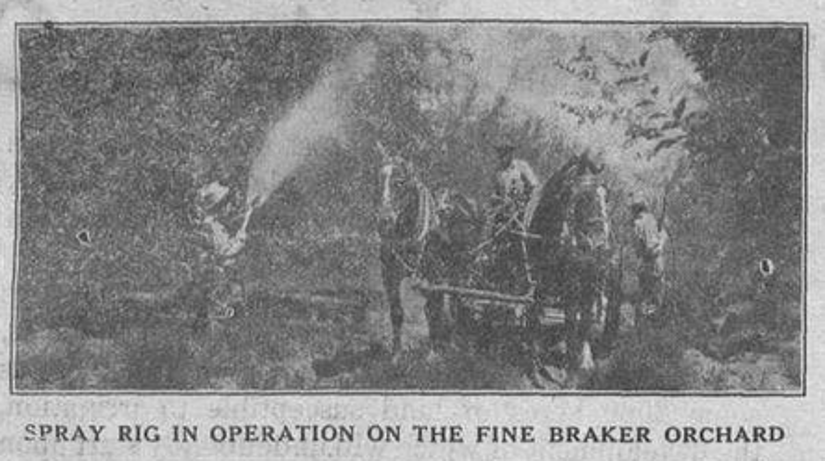
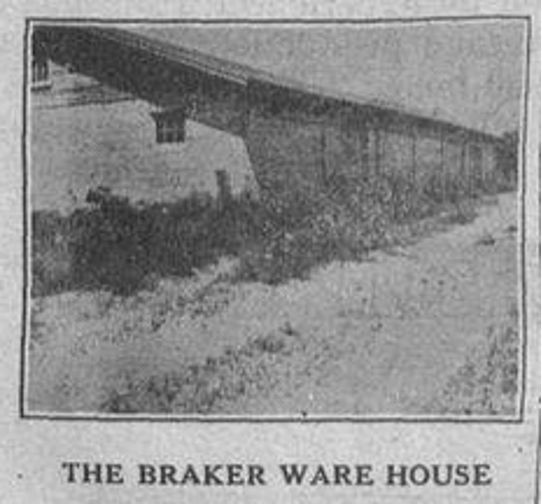
George and Nell continued to raise their family on the Bridgeport Bar and were successful orchardists for many years, but in 1945 George passed away suddenly at the age of 67. Nell lived until the age of 98 and passed away much later in 1985.
Sid married in 1944 and continued working in the orchard industry in and around Bridgeport and Brewster throughout his life. Thelma married in 1946, and while at first settled in Brewster, ended up moving throughout the United States in the 1950s and 1960s due to the Korean War and other life events, eventually ending up in Spokane. Thelma was a registered nurse and volunteered for service during World War II where she met her future husband who was called for service during the Korean War. In World War II they both served together in Patton’s army in Scotland and then, after D-Day, they transferred to France where they served for the rest of the war with the 50th General Hospital Division.
By the mid-1930s, Sid Braker bought the Starr Orchards south of Pateros along the Columbia River (as noted in the Growers section). An article in the Quad City Herald from 1982 indicated that Sid began operating the Starr Ranch orchards in 1941, but dates from apple labels suggest it must have occurred slightly earlier than this time. Either way, by 1962-1963 significant changes occurred for his orcharding business.
In 1962 Sid bought out the D’Georgio Fruit Company, and in partnership with Paul Thomas and Ralph Meenach (and also possibly Clint Paslay), they began the well-known Brewster orchard and packing company called “Custom Apple Packers, Incorporated”. Custom Apple Packers operated for 50 years, from 1962 to 2012. By the 1980s they were estimated to have a pack out of approximately 400,000-500,000 apples annually, with a year-round staff of 12 and a seasonal surge of staff during packing season of approximately 70.
Sid shared that he felt the success of Custom Apple Packers was due in part to their expansion and integration of controlled atmospheric storage coupled with new spraying techniques between the 1960s-1980s. However, their orchards lost a staggering total of 32,000 trees during the awful winter freeze of 1968-1969, but they did recover over time. Speaking of his staff and the local community, Sid had high praise and respect for the people of Brewster, writing in 1982 that he had worked with Jeannette Rilett (bookkeeper), Barry Harrison (warehouse superintendent; see below) and John Hargis (production manager) for 20 years. Sid added, “I’ve been very contented in what I’ve been doing. I’ve been in the principal apple areas of the world and I know we’re doing it better,” adding that ‘the town of Brewster knows “we’re doing it better,” too’ (Quad City Herald January 14, 1982).
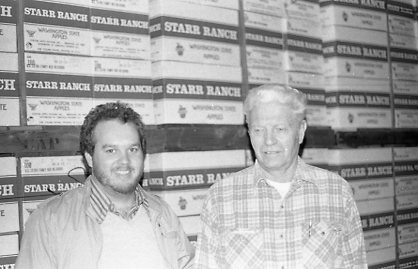
Sid, like his dad before him, passed away quite suddenly at the age of 71 in October 1983, but Custom Apple Packers continued on until eventually selling to the Gebbers Orchards in 2012. As a 2004 history of the company remembered, Sid and his partners had substantial orchards and funds to invest and decided to build Custom Apple Packers from the ground up – literally constructing the packing shed brand new between 1962-1963. The shed opened just in time for the 1963 season and harvest, and Custom Apple Packers ended up working with the ~ten growers, among others, who were flooded out in the Starr Ranch area once Wells Dam was constructed during the 1960s. Sid and his partners also had their own fruit packed at Custom Apple Packers. A fire in August of 1969 destroyed one of the cold storage warehouses, but it was soon rebuilt and replaced.
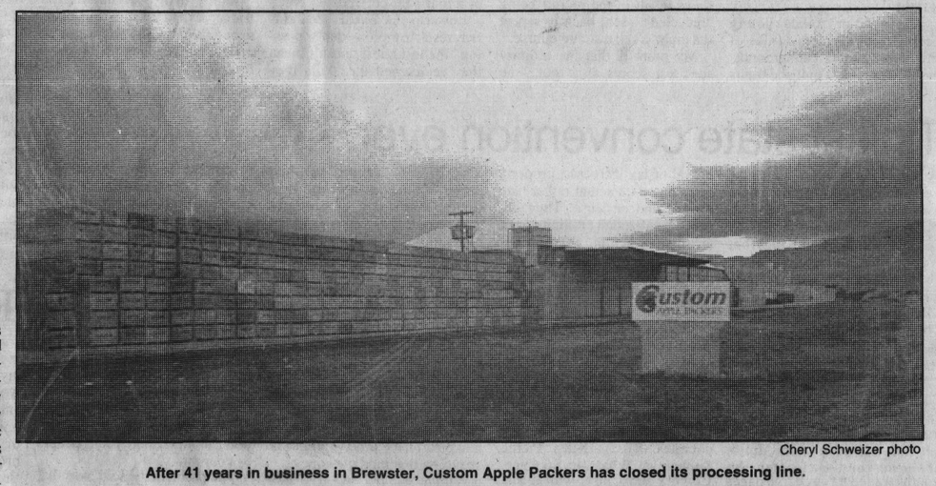
After Sid passed, Dalton and Herb Thomas (sons of Paul Thomas) took over ownership and expanded Custom Apple Packers to include a new packing line, controlled atmospheric storage, and a new loading dock.
Thelma lived until the age of 88 and passed away in April 1998. Sid had one son and a daughter, while Thelma had one daughter. Their descendants live on today in Brewster and elsewhere throughout Washington and the United States. In Brewster, one is hard pressed to forget Custom Apple Packers and the Braker family. They were pioneering apple growers and orchardists for nearly 100 years, and their legacy lives on not only in their businesses bought and sold over the years, but in the physical presence of the old Custom Apple Packers shed still located in Brewster today.
Vernon
Similar to many of the apple growing families in north-central Washington, the Vernon’s arrived in Chelan in 1901 or 1902, after moving from Iowa to start a new life in the west. John and Aranda Vernon had several daughters and sons, including Amelia, Dorothy, Elizabeth, Anthony and Enos – the youngest of the siblings, born in 1896.
This is where I owe a debt of gratitude to Anthony’s daughter, Audree (Vernon) Scott – who is 97 years old! – and shared numerous details about the family history to fill in gaps in their story.
After only six years homesteading in Chelan, John Vernon passed away rather suddenly in December 1907. He was 77 at the time and his two sons, Anthony and Enos, who were 15 and 11, respectively. Struck by the loss of their father, Aranda Vernon leased and rented out the homestead while Anthony worked and Enos began going into town for school. During this period between ~1915-1920, Anthony began working with teams of horses to pull big wheat threshers, and while the horses were pulling the threshers he would sit on top and sew sacks for the grain. This was in Union Valley (north of Chelan) and in Douglas County. But, around 1920 – when Aranda decided to lease out the ranch – Anthony quickly began to recognize the fruit growing potential, and available land, in Brewster and decided to move to Brewster from Chelan. In Brewster, beginning around 1906-1910, the first orchards were irrigated, leading to a rapid expansion of growers, just like in Pateros and elsewhere throughout Okanogan County.
At first, Anthony and Lyda lived and worked at the Beebe Orchards in Brewster. Lyda was a cook and head sorter at the Beebe Orchards outside Chelan (near the Beebe Bridge) for several years prior to this time. They lived and worked together on the Beebe Orchards in Brewster before purchasing their own home and orchard once Anthony’s mom, Aranda, sold the family ranch. Audree noted that both she and her brother were born at the Beebe Orchards in Brewster.
Anthony, his wife Lyda, along with their children John (Jack) and Audree, bought an orchard at the western edge of Brewster, right where the large rock and boulder are located adjacent to the current Gebbers cold storage warehouse on Highway 97. This is where Anthony built their home and starting planting and growing apples, cherries, peaches, and apricots on both sides of the railroad track and road, down to the river. Audree remembers that her family orchards included Winesap, Rome, Red Delicious, and Golden apples. Anthony Vernon also had a cold storage locker later in life, but as Audree remembers, nearly all of Anthony’s fruit went to Methow-Pateros Growers in Pateros for packing, distribution, and sale.
After several years of visiting his brother and their orchard in Brewster, Enos Vernon, while still living in Chelan, bought orchards in Brewster (near Doctor McKinley’s place) and began growing, packing and selling apples. Enos continued to live in Chelan and never moved or lived in Brewster. He hired Charlie Emerson from Chelan to move to Brewster and begin working the orchards. Anthony urged and influenced Enos’ decision to buy into the orchard business, which is how the famous “Mt. Vernon” brand apples from the “Vernon Orchards” in Brewster was created (see below).

While operating successful orchards in Brewster, the Vernon families experienced back-to-back tragedies throughout the late 1930s and 1940s.
Audree remembers that during the winter of 1937-1938 there was a terrible winter freeze in Brewster and that she can still, “hear and remember as a young kid those trees explode”. Their family was unable to replant the orchard and that ended their growing operation. Then, in 1940, Enos Vernon, aged only 43-years-old, died suddenly of a heart attack. His obituary noted that he, “was one of the pioneer fruit growers in the Chelan and Brewster district.”
Two years later, as described in an article in the December 4, 1942, Herald-Reporter (Quad City Herald), Mrs. Lyda Vernon tragically died in a car wreck north of Brewster while Anthony, Lyda, and Lillian (Enos’ widow), were returning in a pickup truck from a Thanksgiving trip to visit with the Waddell family near Mallot. She was only 42 years old. Anthony broke his pelvic bone and spent some time in the hospital healing after the wreck.
Finally, if the loss of his brother and wife were not tragedy enough, Anthony’s son and Audree’s brother, John (Jack), was killed in action in France on March 15, 1945.
Jack was posthumously awarded the Silver Star for extraordinary gallantry while serving with Company I, of the 242nd Infantry Regiment, 42nd Infantry Division near Althorn, France, when he was killed. As his award reads, “When an enemy patrol infiltrated our lines near Althorn, France, through an unguarded opening, Private Vernon immediately tried to warn nearby riflemen of the threat. Unable to attract his comrades’ attention because of the continuous mortar and small arms fire, he advanced toward the enemy group, firing his weapon and yelling [as] loudly as possible. The enemy patrol immediately directed a heavy volume of fire in his direction, fatally wounding him. Private Vernon’s courageous self-sacrifice enabled his fellow soldiers to organize and completely repulse the enemy forces.” Jack is a reminder of the many men and women with ties to the apple industry who served and sacrificed overseas or here at home during World War II.
After the freeze and car wreck, Anthony Vernon was no longer able to easily work in the orchard business, but he did eventually obtain a large cold storage locker which he rented out extensively to other growers in Brewster. He later remarried and retired from the orchard business in 1954. Later in life he entered into an agreement to use the Woodbury Lumber dock in downtown Brewster to help organize a place where all the cherry growers could come weigh and sort their crop for sale. Audree kept track of the books and noted each grower and the weight. Anthony passed away in 1961, at the age of 69, after a battle with cancer. Audree, who also married, eventually moved to Twisp,
When I asked Audree what inspired the “Mt. Vernon” brand apple label imagery she told me that her dad and uncle created it to honor a part of their family legacy or lore that is associated with George Washington. Of course, George Washington famously lived at Mt. Vernon and Washington’s older half-brother originally renamed the estate to “Mt. Vernon” in honor of a British Vice Admiral named Edward Vernon who he had served under in 1741.
Enos Vernon was never sure if this British Vice admiral was directly related to their Vernon family, but he wanted to honor that part of history and legacy as well in their family “Mt. Vernon” brand of apples.
In talking with Audree, she shared with me several special memories of her time growing up and working in the orchards. She remembered once hearing her dad Anthony say – after spraying the orchard – “Well when we got done spraying the lime and sulfur, I could see for miles”. Anthony was not wrong, as it appears that when sulfur is dissolved in water (as it would be in a spray) it has some anti-inflammatory properties, and combined with hot, humid air, could relieve eye dryness and redness/burning, helping to see more clearly. Audree also noted that after the spraying season, families would all head to Soap Lake to bathe, swim, and clean off the chemical sprays.
Audree also remembered that when she was little, her and her brother Jack would run up the little hill next to their property on the western edge of Brewster. They did this whenever they started the hear the clickity-clack of the train coming up the tracks from Pateros. At the top of the hill, they were at roughly the same level as the train conductor and as they would wave, he would wave back and blow the train whistle for them.

