The following section attempts to present a record, albeit briefly and certainly incompletely, for each of the individual families that grew, picked, packed and sold apples under their unique brands. While the grade of apples sold from orchards became standardized throughout the Pacific Northwest in the 20th century (15-16) (Extra Fancy, Fancy, etc.), apple brands were highly individualized to each grower, family, or association. In some cases, individual growers combined efforts and sold together under one brand, but the important aspect of understanding the history of apple growers in Pateros and the lower Methow Valley is that these were orchards where owners sold their crop independently, and outside, of formal cooperative associations of packing sheds and warehouses or advertising agencies (these are described in the next section). Occasionally, individual growers would agree to sell their apples with larger associations, and that occurred within Pateros and the Methow Valley too. Today, these branding and advertising records have become collector items in the form of apple crates and apple labels (16), and many of the records presented here originate from various published accounts of apple label brands and/or museum and private collections of apple labels from the region (e.g., see 17). Other information on these families and growers derives from their own oral history interviews, newspaper articles and museum archives. My goal here is to try and capture the remarkable diversity and resiliency of apple growers and their families throughout the region for well over 100 years as broadly as possible to honor and commemorate their legacy – my own family was a part of this history and I hope these records help honor their orcharding and others.
Averill
Peter and Clara Averill were early pioneers and homesteaders in the Methow Valley arriving sometime the late 1880s or 1890s. The Averill’s had one of the earliest orchards and grew a number of now heirloom varieties. Sally Portman writes in The Smiling Country that there is a small stretch of Peter Averill’s, and another orchardist named James Caddy’s, original irrigation flume still visible along the highway on a Methow River cliffside – drilled holes for steel flume supports line the rock wall. Winthrop’s Shafer Museum also has an early-20th century photograph of the Averill’s orchard along the Methow River (2022.002.121).
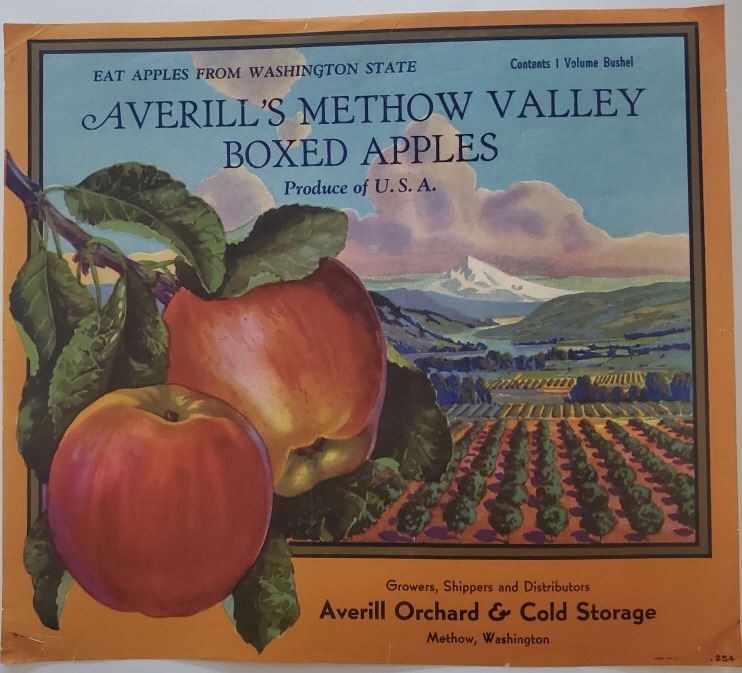
Peter Averill grew, packed, stored, and distributed his apples using a stock format label titled “Averill Methow Valley Boxed Apples” (see below). Although Peter Averill died in 1942, he and Clara had three sons. One son, Ira Averill, died tragically at the very young at the age of 29 in 1932. Peter and Clara’s two surviving sons, Mark and Ralph, both appear to have continued on in the orcharding and apple growing business throughout the mid-20th century until they likely sold their parent’s original ranch in ~1958. Mark Averill died in 1973. Ralph Averill died a few years later in 1978, after retiring in 1972 from his own orchard business in the Methow Valley. Both Mark and Ralph were married but neither had children and it is likely that the Averill apple brand ended in the early 1970s after Mark died and Ralph retired from the business.
Beebe
A name familiar to nearly everyone in north-central Washington is “Beebe”. Based largely out of Chelan – where the Beebe family (or Beebe Orchard Company) successfully constructed their own bridge across the Columbia River in 1919 to help irrigate their orchards – the Beebe’s had direct connections to Pateros and the Methow Valley. The Beebe Orchard Company was technically owned and operated by Junius Beebe and his family out of Boston, Massachusetts, but sometime during the early 20th century they recognized the potential for apple growing in north-central Washington and by 1925 had 40,000 apple trees(18) growing within their own unincorporated community outside of Chelan, along the Columbia River, called “Beebe”. The Beebe Orchard Company owned and operated numerous packing sheds and cold storage warehouses at various towns along the Columbia River, including Pateros. A 1925 Why Beebe Apples are Better booklet(18) notes that the Beebe Orchard Company and Allied Corporations” included the, “Wenatchee-Beebe Cold Storage Co.”, “Wenatchee-Beebe Fruit Co.”, “Beebe-Brewster Cold Storage Co.” and the “Beebe-Pateros Cold Storage Co.” – with John Larrabee as President and H.J. French as manager.
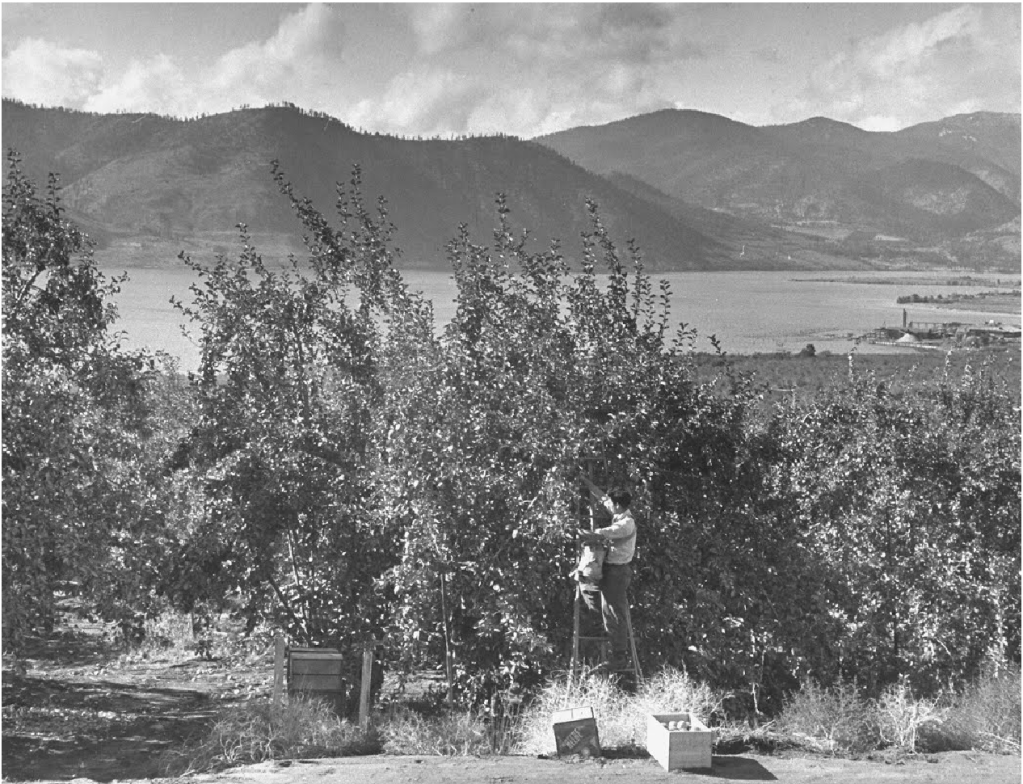
A Great Northern Railroad map curated in the Washington State Archives (AR-270-B-000322) identifies that a brick, two-story “Beebe-Pateros Warehouse Co.” building was located along the railroad track in Pateros by at least 1918. This is likely the same warehouse that John Larrabee later bought in 1925 (11) from the Beebe family for packing, storing, and distributing his own apple crop (see Larrabee and Neff below). The Chicago Packer newspaper noted on October 29, 1927, that the “Beebe-Pateros Cold Storage Company” was incorporated by John Larrabee, H.J. French, Leon E. Cronk, and Arthur Nickel, with a “capital stock” of $60,000 (~$1,077,000 today).
The Beebe Orchard Company had plots of orchard throughout north-central Washington where apples were processed through their packing and storage sheds for sale throughout the United States, and while John Larrabee bought the Beebe warehouse in Pateros in 1925, this did not end the Beebe footprint in town. By 1931 the Great Northern Railroad finalized an agreement to allow the Beebe-Pateros Cold Storage Company to occupy and use space along the railroad track at a space originally constructed and contracted to the “Wenatchee-Okanogan Warehouse Company” in 1920 (19).
Throughout the 20th century the Beebe orchards slowly sold off land and consolidated their orchards in and around Chelan. Horace Smith remembers that during the 1950s-1960s two of the Smith family orchard plots in Brewster were bisected by an orchard owned by the Beebe’s (20) – it was later sold. Apples grown, packed, and distributed under the Beebe Orchard Company in Pateros were labeled using a brightly colored red or blue print with text stating “Beebe Methow” and “Quality Apples”.
Bolinger
If Beebe makes you think of Chelan, then Bolinger must immediately associate you with the town of Methow. The Bolinger’s, and specifically W.A. Bolinger, his family, and descendants, were groundbreaking homesteaders in Methow during the late-1800s and early-1900s where they became merchants and orchardists for well over 100-years. W.A. Bolinger was a Washington state senator (elected in 1904) and is especially known for helping pass legislation to fund the creation of an improved road through the Methow Valley (21).
The Bolinger’s had several large apple orchard tracts in and around the town of Methow totaling around 100 acres and their own packing and storage warehouse located in town that was constructed by the 1920s (2). By 1918 there was a “W.A. Bolinger” spur off the railroad in downtown Pateros (19), and correspondence in the Great Northern Railroad archives confirms that W.A. Bolinger went under contract in 1924 to have an additional 560’ spur track constructed in town (19).
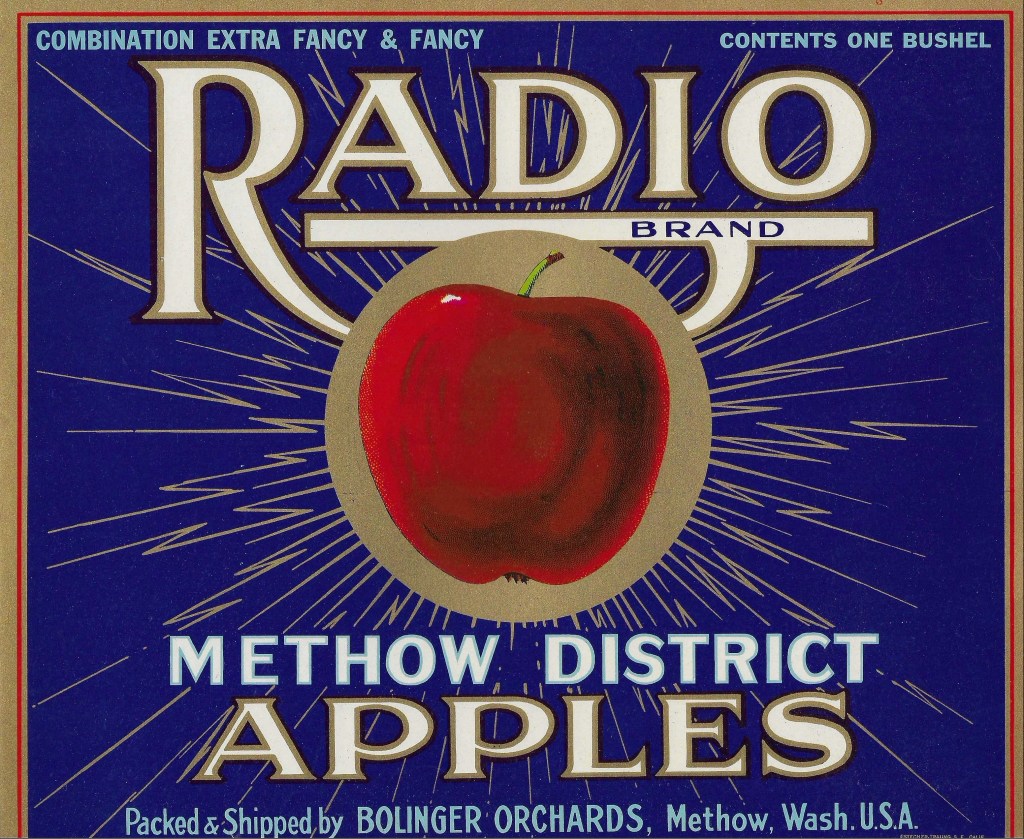
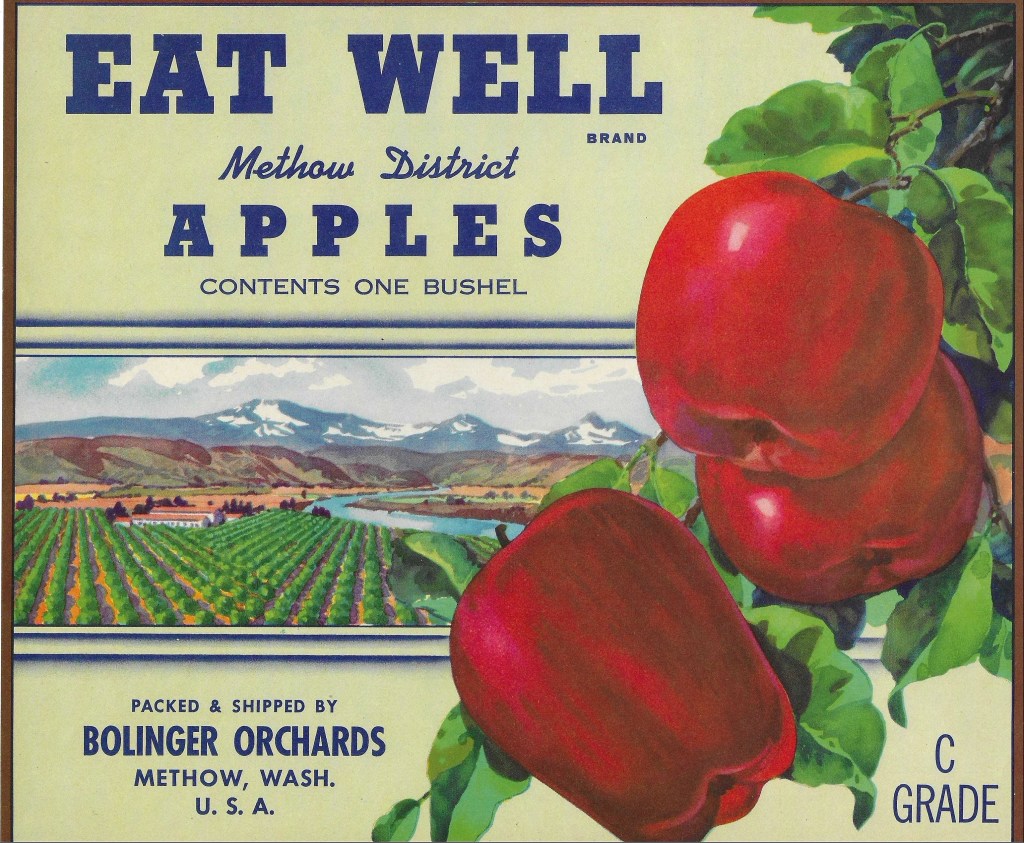
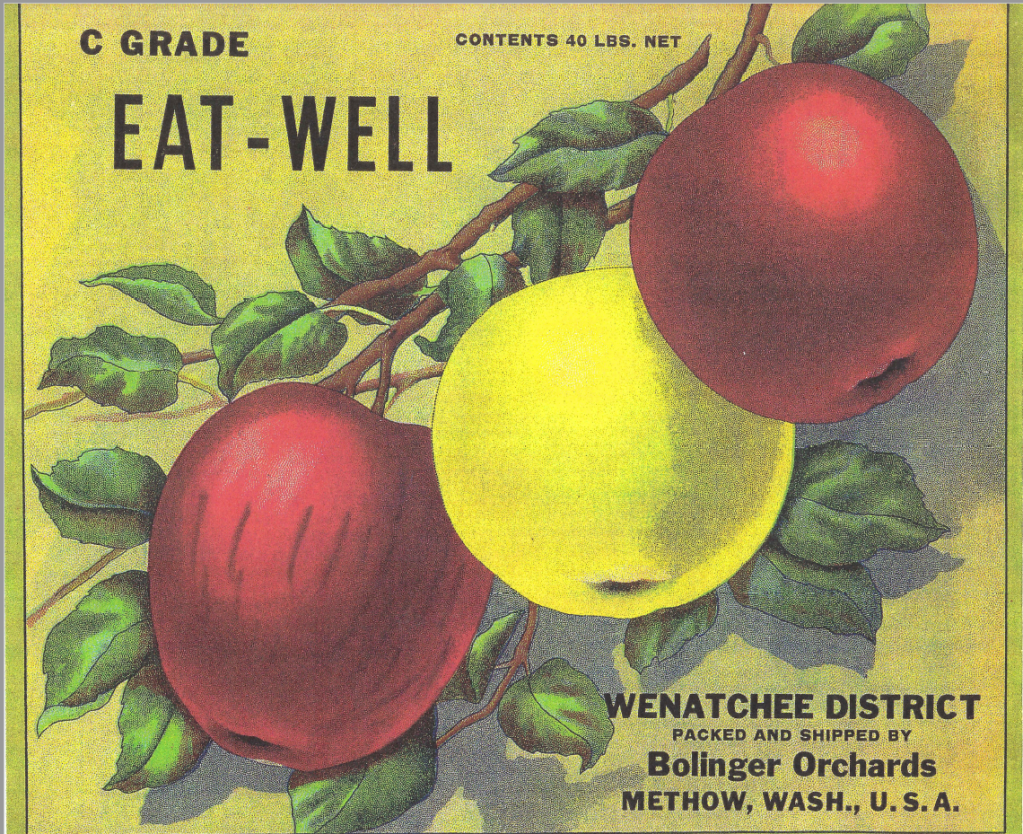
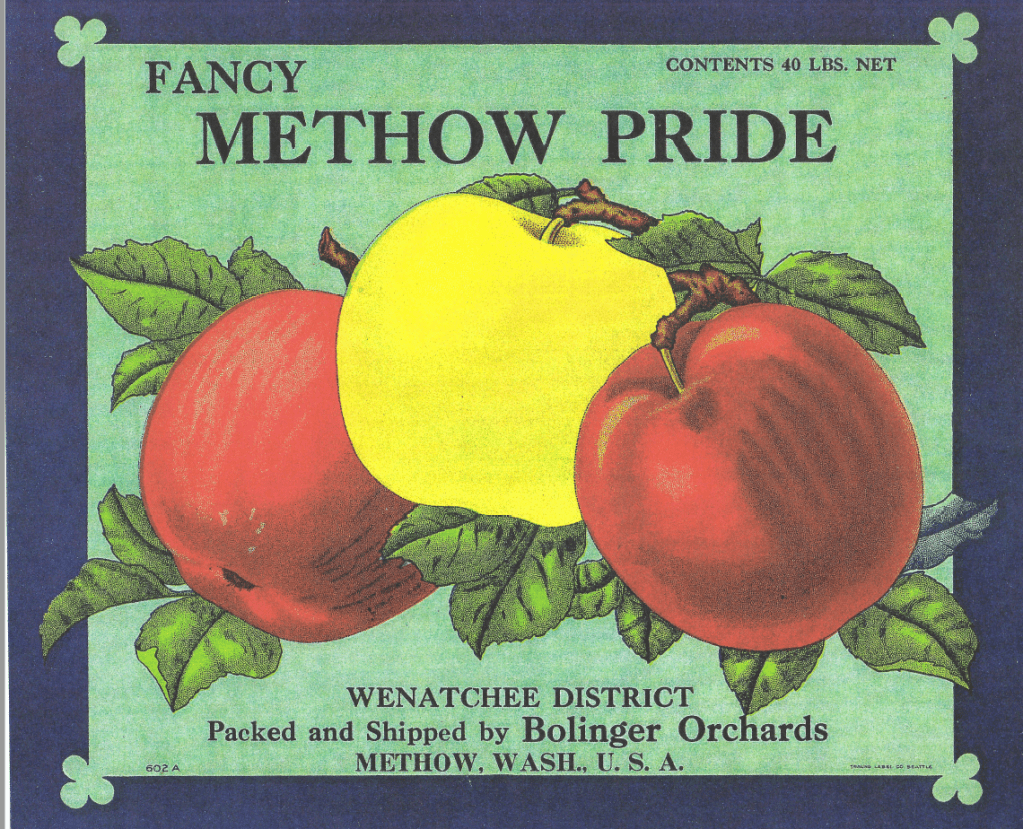
Over successive decades the Bolinger’s apple advertising used a combination of unique text and images – including some stock format depictions of landscapes and orchards – to advertise their apples. Two distinct apple labels from the Bolinger orchards include the “Radio” and “Eat Well” brands. By 1928, when the Better Fruit magazine published their list of “Pacific Northwest Carlot Apple Shippers and Their Brands,” Methow was represented only by the Bolinger’s (and specifically W.A. Bolinger) including their “Radio”, “Eat Well” and “Methow Pride” brands (22). One Methow Valley history noted that every winter the Bolinger’s would depart Pateros for Texas where they would try to sell their apple crop (2).

Cooper
In 1897 William Z. (“W.Z.”) and Martha Cooper arrived in Pateros and purchased land improvements south of town, along the Columbia River – from a “Mr. Smith” – that had an existing crude house and large, planted peach orchard totaling around 12 acres. An Okanogan Independent newspaper article from November 10, 1955, described their homestead by adding that, “the home was a log cabin with a sod roof which leaked and grew grass and other vegetation when it rained. Hugh boulders surrounded the house and covered most of the 12 acres of land.” But the land was perfect for growing.
As the Cooper’s great-granddaughter, Colleen (Cooper) Muller shared, the original farm overlooked the Methow Rapids along the Columbia River and because of their homestead and orchard, the rapids in those early days were often referred to as “Cooper Rapids”. W.Z. Cooper irrigated his orchards using the original “China Ditch” that ran along the west/south side of the Columbia River (the same irrigation ditch was used by the Starr Ranch, see below). According to the Okanogan Independent, W.Z. and Martha’s children, Lee and Frank Cooper, remembered watching the river boats steam up and down the Columbia from their house. The river boats would stop near the Cooper’s house and hook on to a land-based cable to help them pass through the rapids safely.
Very quickly after their arrival in Pateros the Cooper’s entered the fruit business. An unknown newspaper article in the Okanogan County Historical Society collections from February 7, 1936, described their experience in summer 1897. Apparently, after the Cooper’s settled on the land and orchard, their peach orchard had an “enormous” crop. W.Z. and Martha decided to wrap the peaches in paper, box them, take them to Ive’s Landing (now Pateros) to ship them to Seattle by boat for sale. But, as experienced by many growers during this early period, the fruit was a total loss as it was too ripe when picked and spoiled during shipment. Not deterred, and still with peaches on the trees, the Cooper’s hired a group of Native American pickers in Pateros who came out to their orchard, picked the peaches, split them, then spread them upon the large boulders and rocks along the Columbia River. After a few days, the process was repeated, and by fall 1897, W.Z. Cooper took his dried peaches by wagon to the Methow Valley mines, Conconully, and even as far as Republic to sell. He made a large profit and planned to repeat this process again in 1898.
The Cooper’s orchard was quite successful. As previously mentioned elsewhere on this site (see Apple Varieties), the Methow Valley News reported in 1903 about W.Z. Cooper’s large Wolfe River apples that he brought to the news agency and that his trees were, “arranged so that the fruit from the tallest limb can be gathered while standing on the ground.” By 1908, however, a cold and hard winter killed many of the trees and the Cooper’s replanted their 12 acres with a close plant of 1,500 Winesap and Delicious trees – 75% of the orchard was Winesaps at that time.
W.Z. and Martha’s son, J.L. Cooper took over the orchard in 1926 and also expanded by planting a pear orchard within the town of Pateros itself. The Cooper orchards totaled around 27 acres by 1930. While he managed the Cooper orchards, he also was one of the original organizers of the “Methow Valley Growers Service” cooperative of growers that was based in Pateros. He managed this association for over 10 years (see “Cooperatives” section).
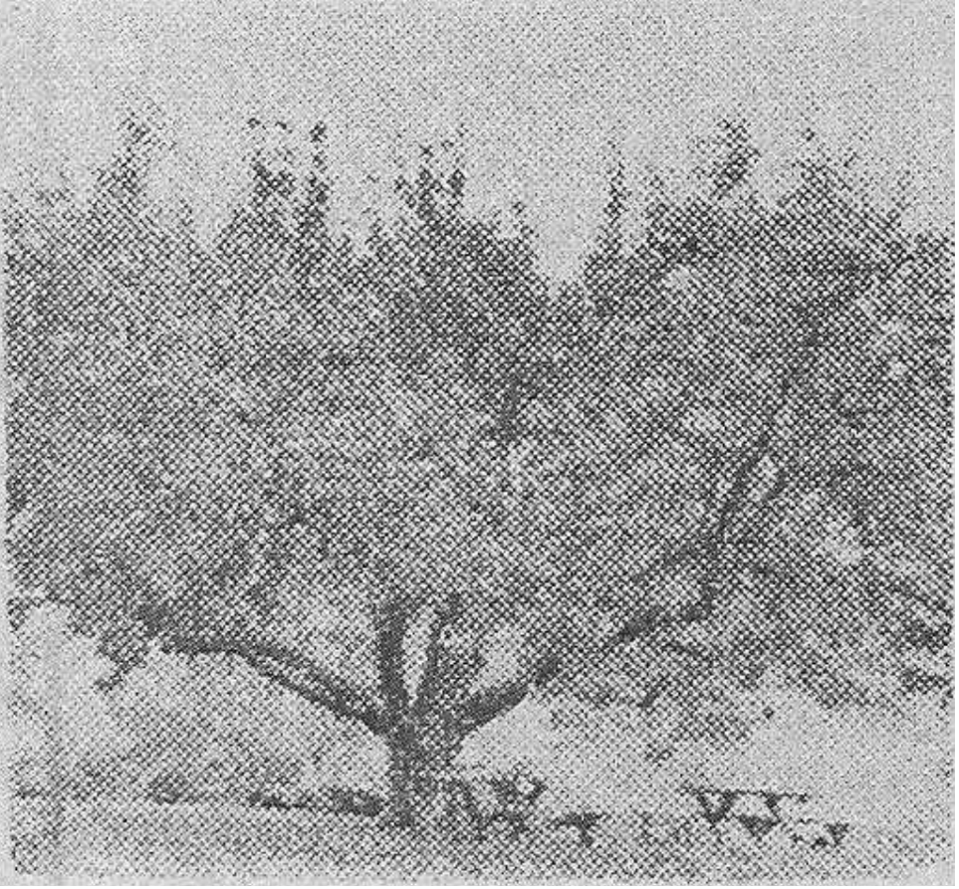
One interesting piece of apple tree history tied to the Cooper’s is that by 1955 a 63-year-old Red Astrakhan apple tree was still bearing large crops of apples annually at the original homestead (see photograph below). This indicates that the tree was planted in ~1892, by the previous owner of the Cooper orchards, Mr. Smith.
Later, in the 1950s, J.L. Cooper, his son Calvin Cooper, and J.L.’s son-in-law, Blaine Madden, planted orchards between Pateros and Brewster, next to orchards planted by John Neff (see below). They purchased 57 acres of land southwest of Brewster in 1947 and the Okanogan Independent reported that in 1950 the first trees were planted, including 300 Winesaps, 500 Starking Delicious, 50 Golden Delicious, and peach and pear trees as fillers. Additional plantings occurred in 1953 and 1955.
While the first crop of peaches from the Cooper and Madden orchards was harvested in 1953, numbers from 1955 indicate that 5,300 peach lugs were packed and sold, including 500 locally – no doubt using the peach crate label shown below. During this same time, they packed and sold 325 boxes of Golden Delicious, 2,910 boxes of Starking Delicious, and 2,026 boxes of Winesap apples. In 1955 the highest producing Golden Delicious, Starking Delicious, and Winesap trees produced, 17, 15, and 13 boxes of apples, respectively.

The legacy of the Cooper family also lives on through Cooper Mountain, between Pateros and Chelan. As the family story goes, W.Z. Cooper saw land surveyors working up the hill from his orchard one day and decided to bring them fresh peaches from his orchard. The surveyors were so thrilled that they decided to name the mountain, “Cooper Mountain”.
Couche
Originally from Birkenhead, England, Dr. James Buxton Couche arrived in the Methow Valley in 1900 after working and living throughout Canada, the U.S., and Mexico (History of North Washington 1904). After graduating with his medical degree from Toronto University in 1899, and spending time in Molson, Washington (among other locations), he settled in Twisp and opened a physicians practice. The 1904 History of North Washington described that “Dr. Couche has won for himself a practice that bespeaks both ability and energy, while his standing with the people is of the very best. He owns various mining property and also has a homestead adjoining the town of Twisp.” Okanogan County property records suggest that Dr. Couche’s homestead was located near the modern-day juncture of Highway 153 and Highway 20.
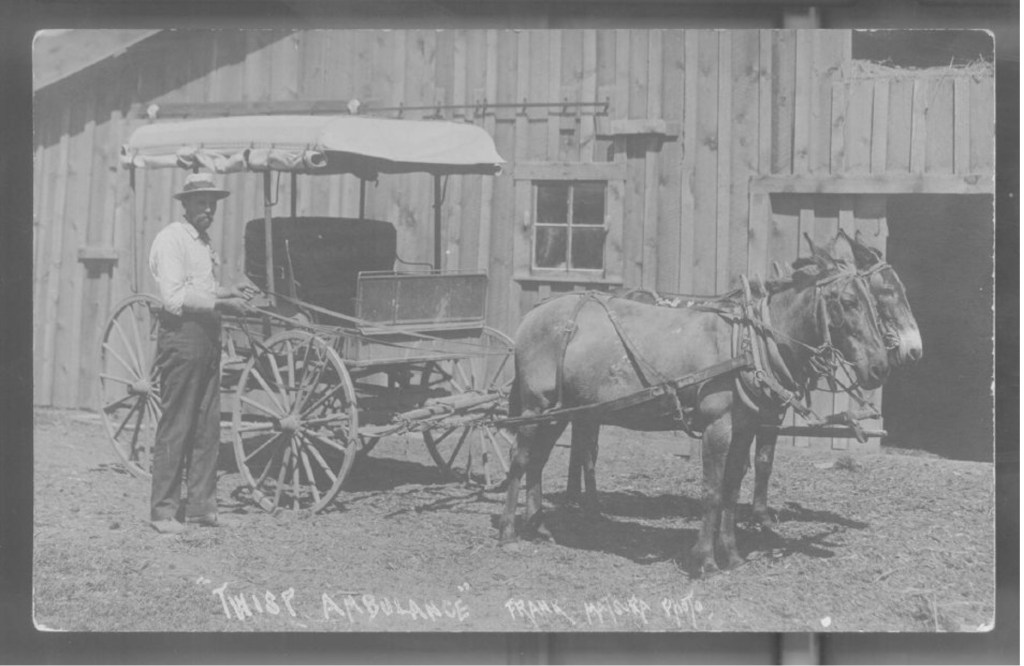
Although newspaper records are intermittent, by September 11, 1909, the Brewster Herald noted that Dr. Couche and his family were living in Twisp and were well-known in the community at that time. Being one of the first doctors in the Methow Valley certainly was significant. Photographer Frank Matsura captured a moment with Dr. Couche standing next to this “Ambulance” in Twisp during this period.
During World War I, Dr. Couche joined the U.S. Army as a physician. One Methow Valley News article indicated that in March 1918 he was stationed in the “Spruce camps” in Clark County, Washington, near Vancouver, where “large forces are getting out timber for airplanes.” Eventually, he moved and was stationed in Fort Bliss, Texas, in early 1919. This is where – thanks to assistance provided by Dr. Couche’s grandson and granddaughter-in-law, Ken and Lynn Couche – we now know where the story takes a tragic turn.
James and his wife, Ethel Adrienne, had three children, the youngest of which was only a few months old in January 1919 when he caught influenza. Mrs. Couche, with her two toddlers and newborn, set out from Twisp to meet her husband in Texas, but she died en route in Denver, Colorado, after catching influenza herself. Her son and two other children survived. The Brewster Herald reported her passing and noted that Mrs. Couche was a talented musician known throughout north-central Washington. Ken Couche noted that James and Ethel married after they met while sailing on the Lusitania from England to the U.S. in 1912.
Struck with the loss of his wife, and with three young children to care for, Dr. Couche returned to England to be with his extended family. He continued to serve as a physician on troop ships sailing to and from the United States and Europe during this time.
Dr. Couche eventually returned to north-central Washington, but only for a short period while he sold his assets and property. In 1922 he briefly practiced medicine in Entiat, Washington, and by 1923 he left Twisp, the Methow Valley, and Washington to return to live in England. After doctoring in Birkenhead and raising his kids, he then put them all on a steamer and moved back to the U.S. in 1934, settling in San Diego, California. Dr. Couche in someways was lucky because he missed, by one year, the great Twisp fire which destroyed most of the town in 1924.
One additional Methow Valley News article reported that Cuthbert Villar (brother of Jack Villar) returned home to Birkenhead, England, and met with Dr. Couche and his family in spring 1925. The Villar brothers were convinced by Dr. Couche to move to the Methow Valley many years prior and they were all originally from Birkenhead.
While there are few records of Dr. Couche owning and operating an orchard, several versions of a surviving Skookum apple label (see below) and one Methow Valley News article indicate that he did own an orchard, outside of Twisp, during the 1910s and early 1920s. Sold under the “Bidston” brand, the printers of this label accidentally misspelled the town name “Peteros” instead of Pateros. Bidston itself refers to the old, original village of Bidston found within the greater city of Birkenhead, England. Ken Couche indicated that one prominent feature of Bidston, even today, is a large windmill on top of the village hill. The windmill was originally used to pump water. Thus, a fitting name for the heavily irrigated orchards in the Methow Valley that Dr. Couche would have encountered during his time.
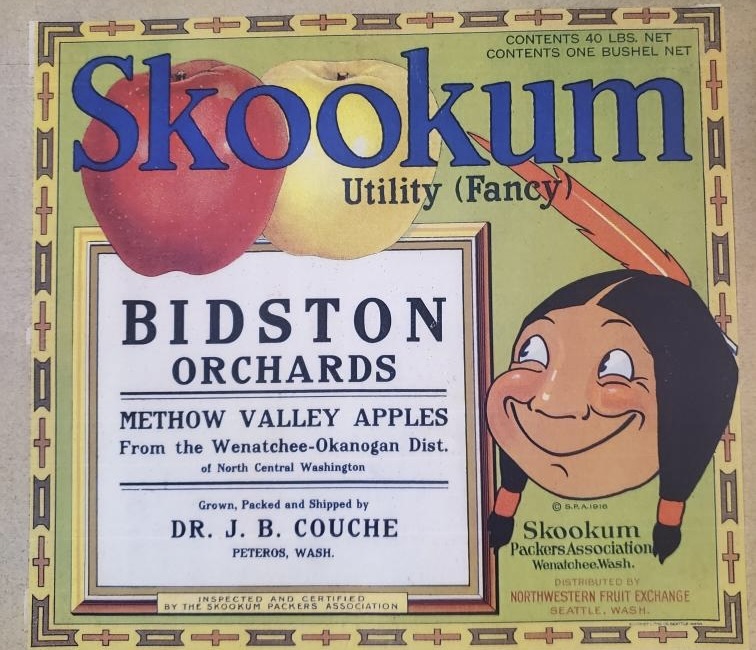
One final local record of Dr. Couche occurs in the Omak Chronicle on September 15, 1955, which was titled, “Dr. Couche Holds Reunion.” He returned to Twisp for a Labor Day Pioneer picnic with a group of the (then adult) children that he delivered and some of their parents. Dr. Couche died in England only a few years later.

Crane
As previously mentioned, the Crane’s based out of Pateros and Brewster, were another family with deep orcharding roots in the region. By 1909 George Crane was planting and growing apple orchards across the Columbia River from the towns of Pateros and Brewster. In 1922 the Oroville Weekly reported that by irrigating from the Columbia River and establishing his own sawmill to produce apple boxes at his orchard, he expected to harvest 75,000 boxes that year alone. Crane’s warehouses included one on his orchard and another in downtown Pateros where he, “owns a large boat with which he conveys his apples across the [Columbia] river to the railroad at Pateros.”
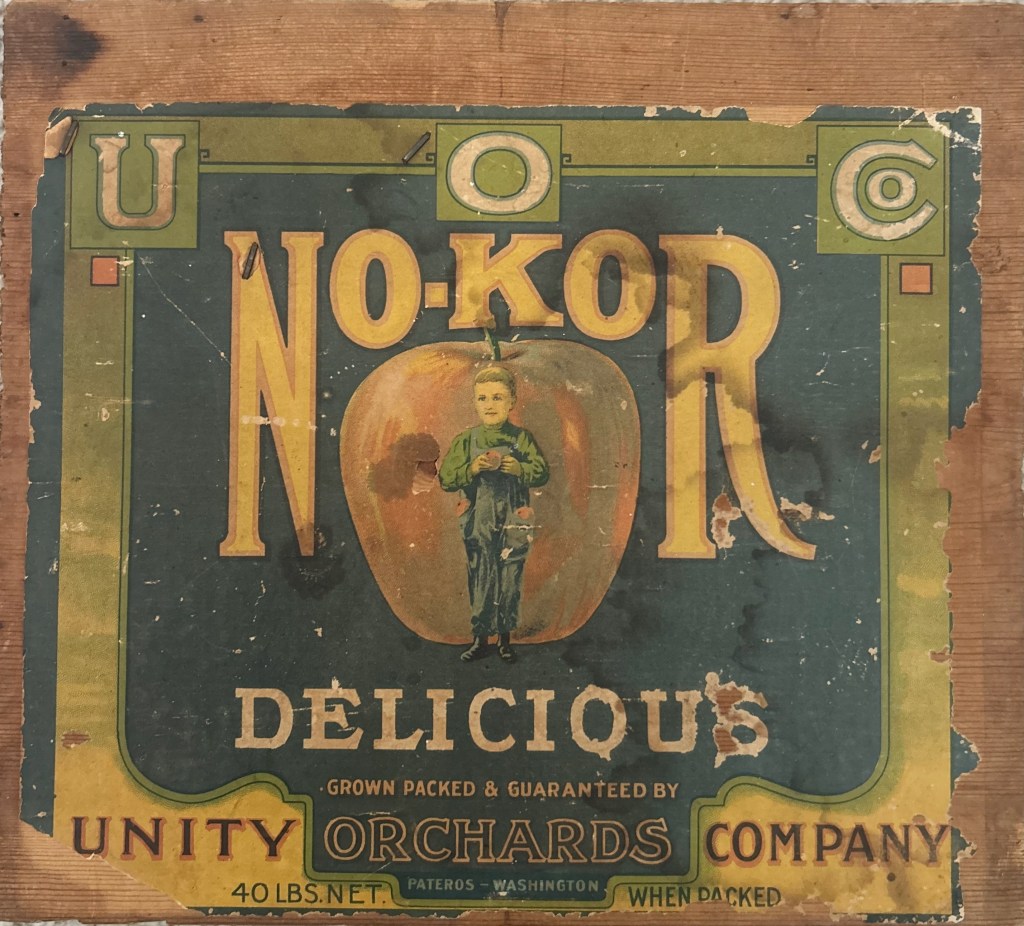
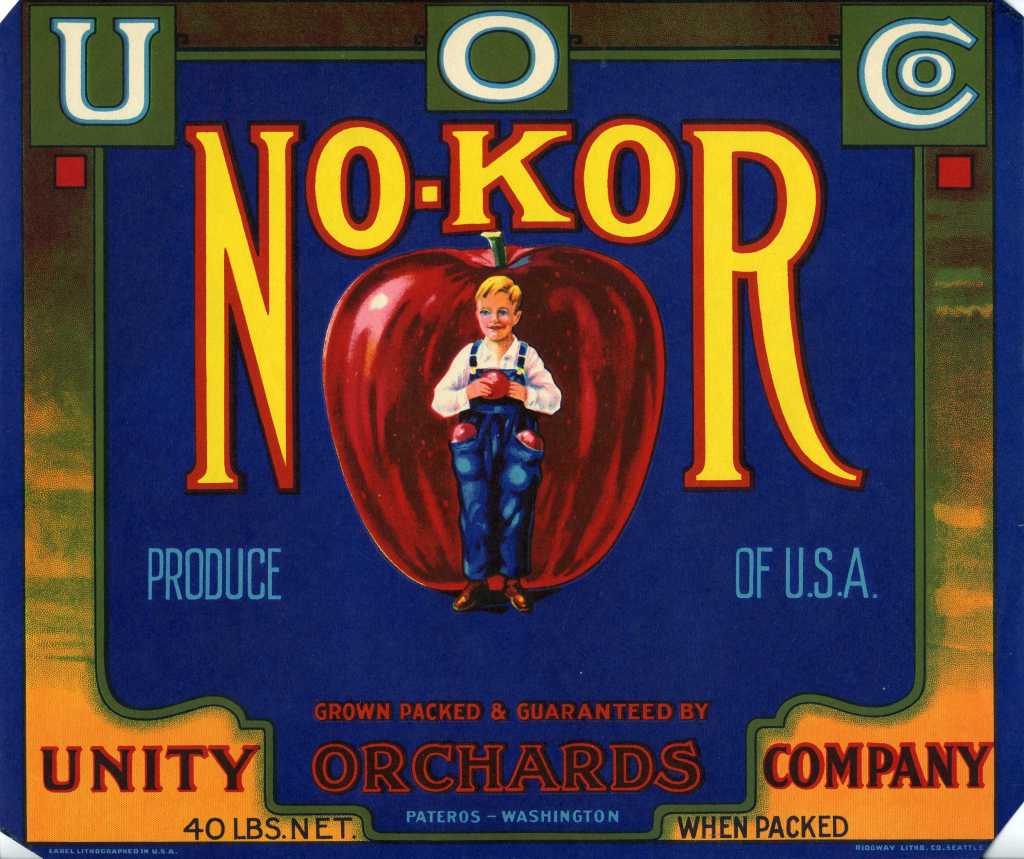
Crane family orchards were also known later in time for their “Crane” or “Crane and Crane” brand apples out of Brewster, but in the early 20th century George Crane and Frank Crane originally sold under the “Unity Orchards Company” (22). This included the well-known brand “No-Kor” depicting a small boy standing in front of an apple. George Crane, and later his son Francis Crane, were heavily involved in many different cooperatives during this period. As the Chicago Packer reported in 1922, George Crane, acting as president of the Brewster Orchards Company, signed a marketing contract to sell apples under the “Skookum” brand with the Northwest Fruit Exchange in Wenatchee. Many growers in the Methow Valley and elsewhere signed similar agreements and sold with the Northwest Fruit Exchange (see below).
One interesting account from the August 6, 1927, Chicago Packer also announced that the Chicago company “G.H. Cross” – with a tagline “Cross for Quality” – was the exclusive distributor of Delicious, Winesaps, Jonathans, “Spitz” (Spitzenbergers) and Newtowns from “Pateros, Brewster, and Okanogan districts,” including as the:
“exclusive distributors of the famous “NO-KOR” Brand packed by UNITY ORCHARDS CO., Pateros, Wash. 100 cars Delicious, Winesaps, Jonathans, and Spitz”

Culver
A March 16, 1928, Quad City Herald article quoted Fred D. Culver as saying, “I am more enthusiastic than ever over the possibilities of the apple game. The apple grower has fewer troubles and worries both from the standpoint of production and of distribution than the citrus, nut, and other growers of the south and southwest.” Culver and his wife had just returned from a three-month trip visiting fruit growers throughout the U.S. South and Southwest and was clearly impressed with apple growers in the Methow Valley of which they were a part. The Culver’s had their orchards north of the town of Methow, in the town of Carlton, and they were well-known orchardists at the time. By the early 20th century the Culver’s were growing, packing, and selling apples under their own brand.
Once, in 1910, members of the Washington State Press Association took a tour by automobile from Pateros to Twisp led by a group including the Okanogan Steamboat Company and the “Furey-Culver Land Company”. Their account was published in the November 4, 1910, Leavenworth Echo and provided a memorable description. The press association wrote that the road up the Methow Valley was “primitive”, and that aside from the portions of road constructed by convicts (thanks to W.A. Bolinger) driving the nearly impassable hills and embankments, “was like going through purgatory to enter paradise.” Their description of the valley quickly fell into romantic notions of comparisons to Switzerland and described that, “[w]herenver could be found a block of level land there has been planted an orchard and a home.” Eventually the group made it to Methow where they stayed the night and then continued to Carlton and Twisp in the morning. In Carlton they described that the Furey-Culver Land Company essentially owned the entire town, and as a realty company, sold irrigated tracks to prospective farmers and orchardists. They stopped at Fred Culver’s ranch and the description can’t be paraphrased:
“On the return trip the party stopped at the beautiful home of F.D. Culver, of the company, and inspected one of the few old orchards in the valley. It is a small one, containing a dozen varieties. This orchard was never sprayed. No fruit pests have made appearance in the Methow valley. Mr. Culver offers a box of apples for every wormy fruit which may be found. One may bite into a Methow apple in the dark without danger of breaking up a happy family. Great, luscious, highly-colored fruit hung from the trees in clusters that threatened to break the branches. In this ranch there are 179 acres, which the Messrs. Furey-Culver are planting to apples. It lies beautifully, with a gentle slope to the Methow river, is easily irrigated and will become a forture [sic] producer in a few years.”
A Great Northern Railroad map of Pateros in 1915 also indicates that Fred Culver was under contract for a spur or warehouse space along the railroad line – and a second, later dating map indicates that “Culver Realty” had similar contracted space (19). At one point the Chicago Packer wrote on February 27, 1932, that Culver was known for, and continuing, his practice of “holding his entire crop of Delicious” for sale in March (the paper also noted that John Larrabee followed a similar practice). The Methow Valley News used Culver to help explain on May 18, 1928, that by keeping apples in cold storage – for this example a “carload of Rome Beauties” grown in Culver’s orchard in the Methow and stored at Methow-Pateros Growers, Inc., in Pateros where he was a member – growers could net over a $1.00 more per box than if sold in the fall.
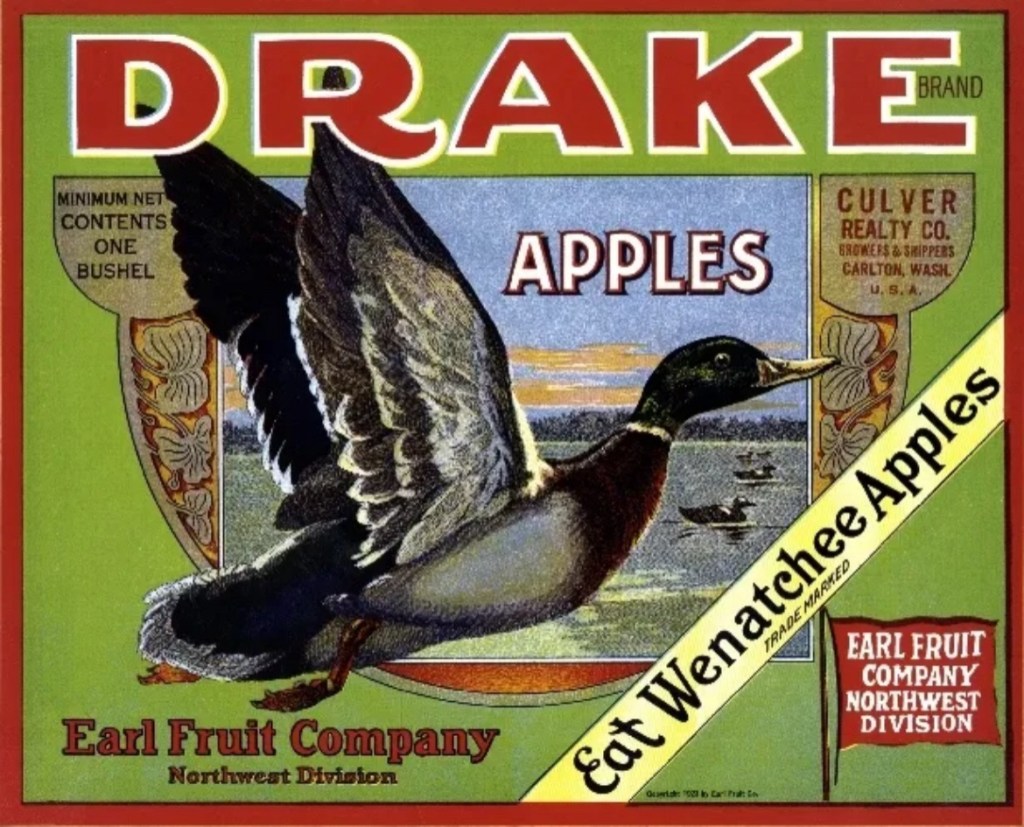
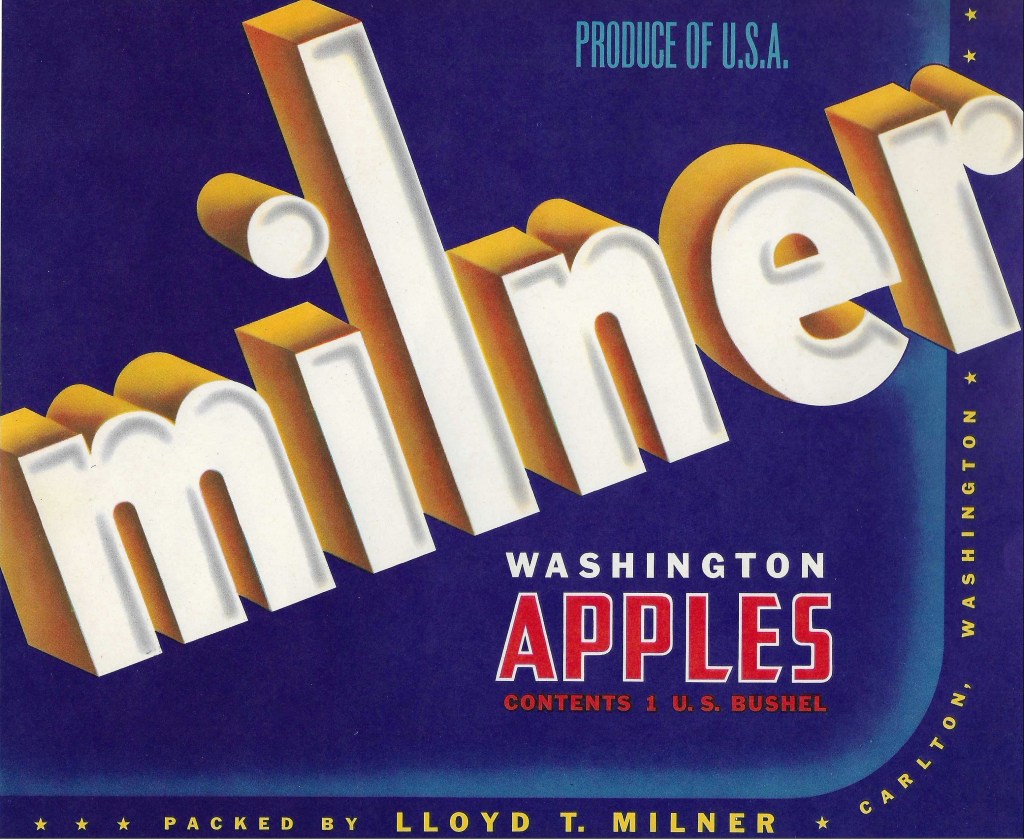
Of the apple brands and labels known from the Methow Valley, Culver’s is especially unique – and oddly specific in its imagery. Their standard label used the text “Culver” spread across a red or blue background with an image of a soldier standing at attention in the top corner. The labels typical stated “Culver Realty Co. Inc.” as the grower. Culver had extensive business partnerships throughout Washington, and this is also highlighted by his apples being sold as part of the Earl Fruit Company “Drake Apples” sold out of Wenatchee. It is unclear exactly when Culver began growing apples and when he subsequently stopped and sold his orchard, but by the early 1940s articles in the Methow Valley News indicate that the Milner family had bought the Culver orchards in Carlton and began selling under the Milner brand.

Downing
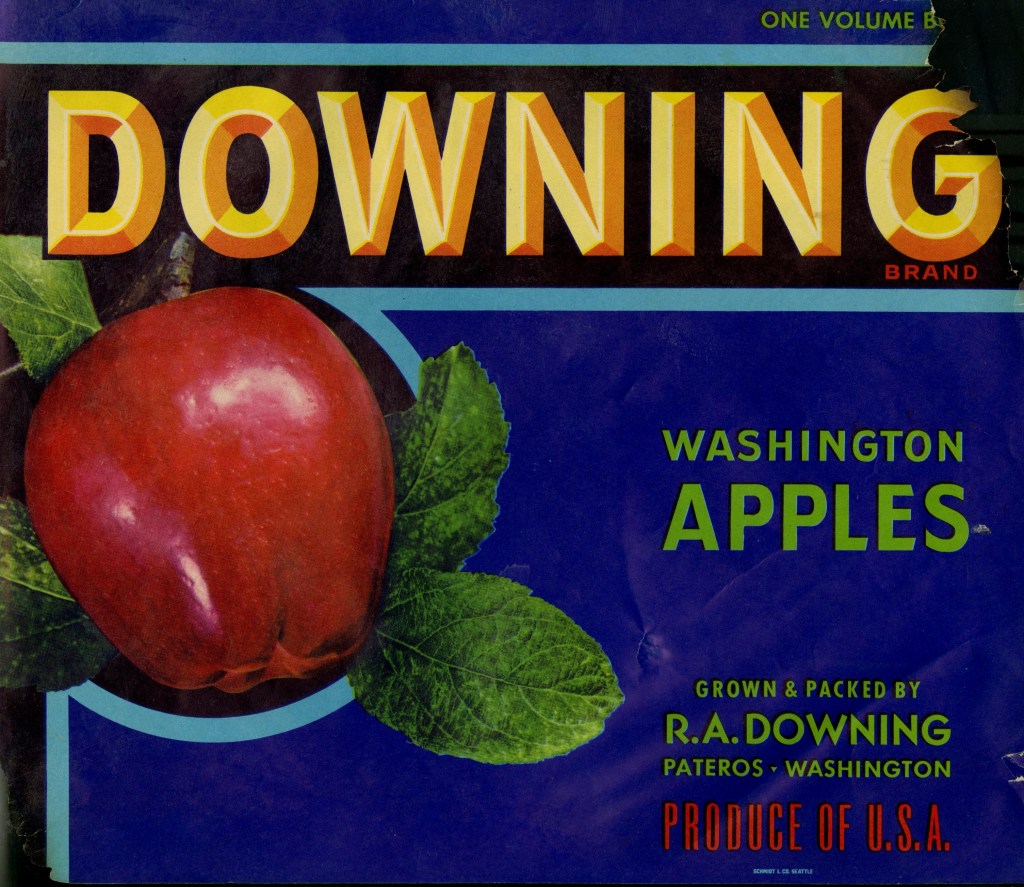
There is a known apple label with a dark blue background, shiny red apple, with yellow and golden lettering across the top spelling “Downing Brand Washington Apples”. These apples were “grown and packed” by R.A. Downing in Pateros. But, little is known – at least in historic records I could access – about Robert Alden Downing and his apple orchards. His 1951 obituary does indicate that he and his wife, Ruth Peckenpaugh, moved to Brewster from Spokane in 1915. During their time in Brewster, Downing was the mayor of the town for over seven years, was involved in the Commercial Club, First National Bank, Okanogan Valley Power Company, and several other organizations. His orchards were apparently located on the Bridgeport Bar (east of Pateros) but his packing shed was in Pateros, and the Shafer Museum does have a historic photograph in their collections taken during the 1948 flood showing Downing’s packing shed surrounded by water (2003.001.096). The Downing’s evidently had no children, and it appears that their apple orchards ceased selling under the “Downing” brand sometime after their death.
Larrabee and Neff
Of all the apple growers within Pateros and the Methow Valley, the Larrabee and Neff’s hold a special place to me because of my own Jess family history and connection with these families. The bulk of the Larrabee, Neff and Jess orchards were adjacent to each other along the Methow River north of Pateros, they drew from the same irrigation ditch constructed by John Larrabee (in 1910; see [11]), they worked in the same packing sheds and warehouses in Pateros and up the Methow River (see photos below), and for the Jess family at least, they worked for and sold nearly all of their apple crop under the Larrabee and Neff brands. Simply put they were friends and companions – when John Larrabee died in 1952 my great-grandfather was one of the pallbearers at his funeral. This also makes understanding the Larrabee and Neff history uniquely challenging because of my own anxiety to ‘get it right’! Joan and Phil Brownlee’s 2010 oral history has certainly helped fill gaps in this story (11) and I try to summarize that account, and others, below.


John Larrabee arrived in Pateros and the Methow Valley in 1909 and immediately got to work planting and growing apples just north of town on a tract of land he purchased along the river (11). After living in Indiana and having a career as a lawyer in Seattle, Larrabee eventually settled in Pateros because he disliked the wet and rainy climate of Puget Sound and wanted to pursue apple growing. Joan’s father, and Larrabee’s nephew, John Neff, also eventually made his way to Pateros from Indiana in 1924, and was followed two years later by his brother, George Neff (Joan’s uncle) in 1926. This brought together the families, land, and orchards which came to be known as “Larrabee and Neff”. It is important to note that Larrabee and Neff also had a large orchard near Malott, and later in life Larrabee bought an orchard in Ellisforde where he was living and growing apples until his death (Larrabee had one son who continued orcharding after his death).
Prior to the arrival of John and George Neff, John Larrabee was busy in Pateros and the Methow Valley growing apples and establishing his warehouse and brand for distribution. As previously noted, Larrabee was well known for his apples, especially Winesaps. He built his first packing and storage warehouse up the Methow River from Pateros in 1915, and by the 1920s he was also working for the Beebe Orchard Company before eventually buying their warehouse and cold storage facility in Pateros. Joan Brownlee remembers that Larrabee did not like how the Methow-Pateros Growers association (see below) packed and shipped their apples which is why he pursued his own brand and operation. By ~1919 the first large crop of apples was picked from Larrabee’s orchards in the Methow and by 1924 or 1925 during a particularly memorable season, 42 train cars were packed full of Larrabee orchard apples bound for Chicago (11). It took a week of around the clock work to pack all the cars full of apple boxes.
After the Neff’s arrived, Larrabee and his nephews continued to plant, grow, and distribute apples. At some point during the early 1930s Larrabee experimented with an early version (and likely first for Pateros) overhead sprinkler system for apple trees, only to discover that calcium deposits would aggregate on the apples and were difficult to remove prior to sale. Larrabee also traveled across the U.S. to sell and promote their apples. The Chicago Packer reported on June 22, 1935, that Larrabee was in New York “handling the sale of his Winesaps”, of which he had 14 rail cars full in cold storage. Larrabee was known for holding his apples – just like Fred Culver – for sale late in the season when prices were better. One 1930 Chicago Packer article described the process well:
“Mr. Larrabee believes in capitalizing every point and every advantage that his orchard possesses. In following out this policy he has made it a rule to grade and pick his Winesaps as quickly as possible and put them into cold storage within a comparatively few hours after they are picked. This prevents any breaking down processes which might lead to premature decay.”
During the disastrous 1948 flood in the Methow Valley, the Larrabee and Neff packing shed and warehouse in Pateros was flooded and newspaper accounts suggested that anywhere between 5,000-10,000 boxes of apples were swept away in the flood waters (at least one box made it all the way to Kennewick, WA, floating down the Columbia River). John Larrabee died only a few years after the flood, but the Neff family (and later corporation) continued growing, packing, storing, and selling their apple brand. Great Northern Railroad records indicate extensive correspondence and contract negotiations between the “Neff Brothers” (the family corporation) due to the construction and flooding of the Wells Dam in the late-1960s. The Larrabee and Neff brand had several warehouse facilities along the railroad tracks in downtown. John E. Neff died in 1975 and his son, John F. Neff, took over management of the operations until 1983 when John E. Neff’s daughter, Joan Brownlee, began managing the orchard, warehouse, and packing shed until it was sold in 1992 (11). George Neff died in 1984.
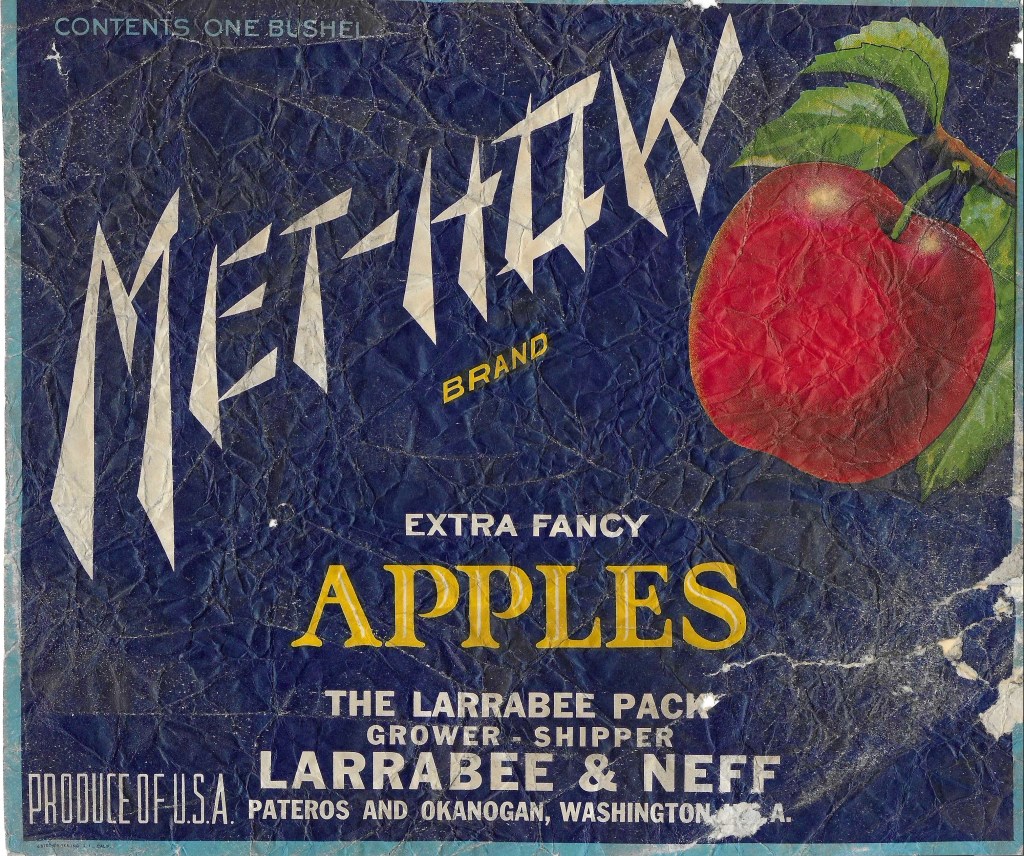
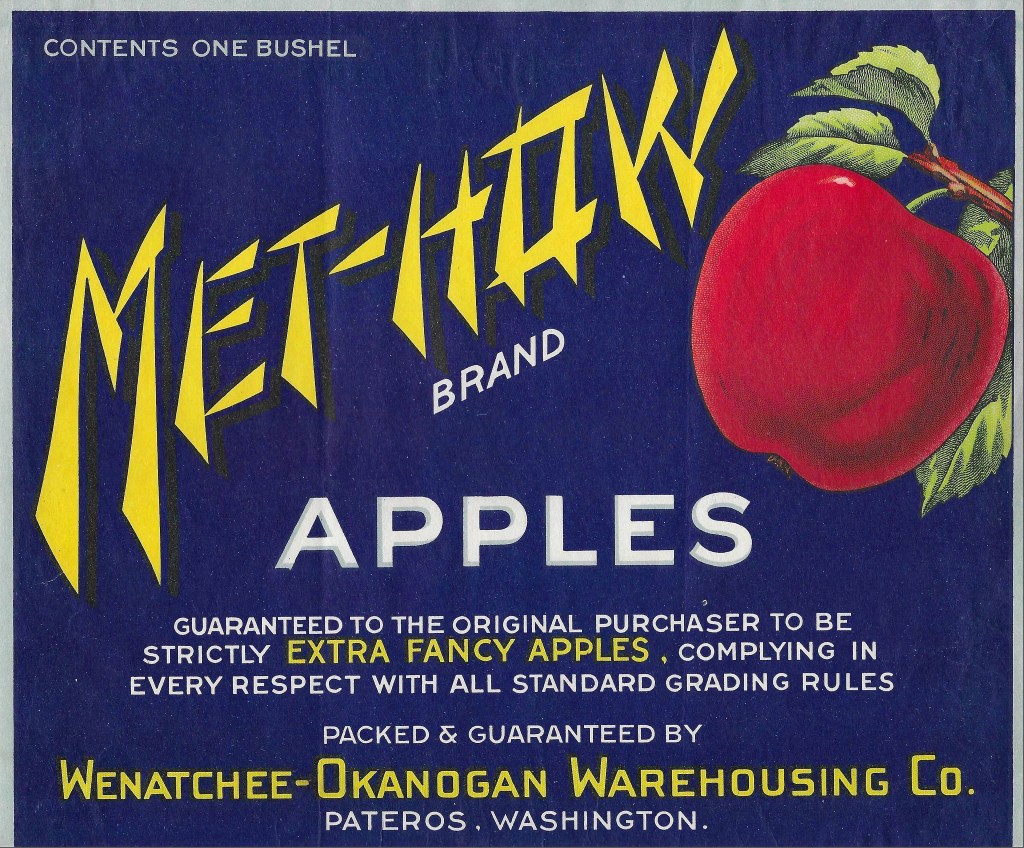
Eventually the Neff Orchards expanded to include acreage between Pateros and Brewster which was purchased in 1955 after John Larrabee’s death. In the 1980s when Okanogan and Wenatchee newspapers reported on the Larrabee and Neff orchards and their current operations, Joan described that the family had approximately 150 acres growing Red Delicious, Golden Delicious, Granny Smith, and some pears. Joan remembered that she “got her start early” when John Neff would bring home boards (”shook”) for his children to assemblage and put together apple boxes. For John Larrabee and the Neff’s, they consistently sold their apple crop under the brand created by Larrabee in the early-20th century called “Met-How”. It is one of the most well-known Pateros apple labels and is widely known. The labels feature the text “Met-How” angled across a blue or red background with a colorful red apple typically depicted in the corner. Larrabee and/or Neff are listed as the growers, packers and shippers depending on the pack (e.g., Extra Fancy, Fancy, etc.) and orchard location.
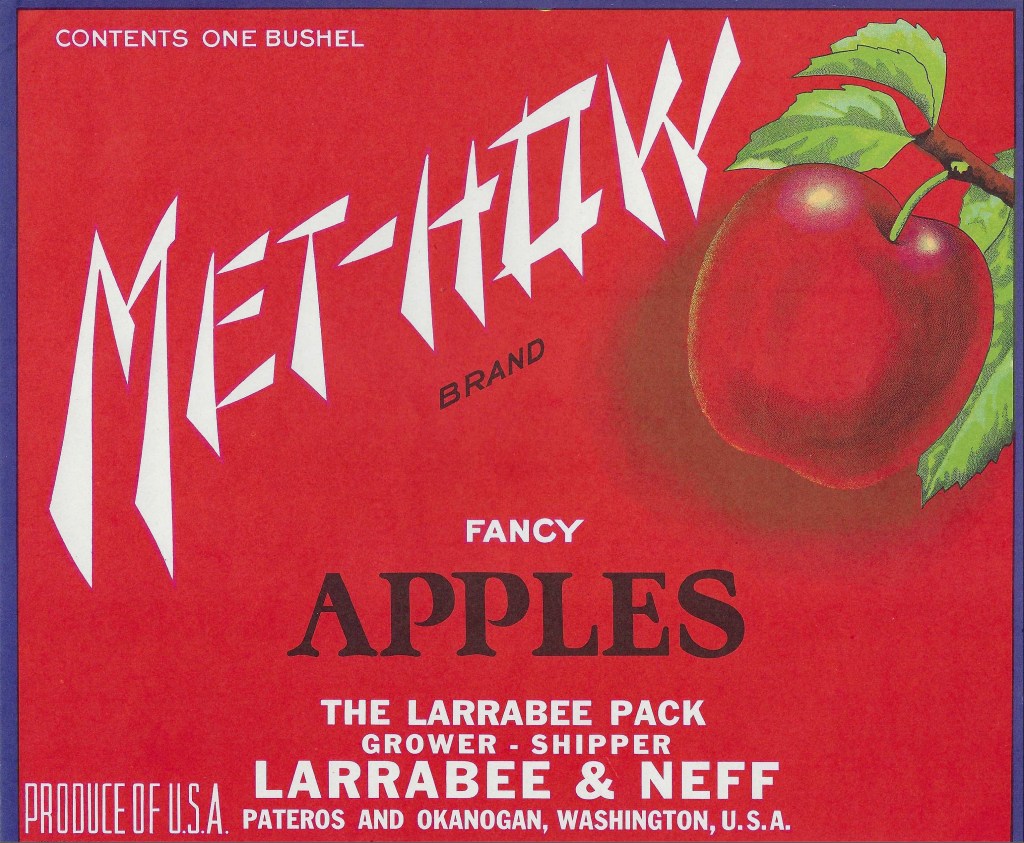

Nickell
Driving up Highway 153 today, you might notice – just south of the town of Methow – the name “Nickell Orchards” on a faded sign lining the exterior wall of a Gebbers Farms warehouse. How the name Nickell ended up on that warehouse is a fascinating story of different sets of brothers, separated by generations, all originating from the same early pioneering and homesteading families in the Methow Valley. The story begins with Harvey and George Nickell.
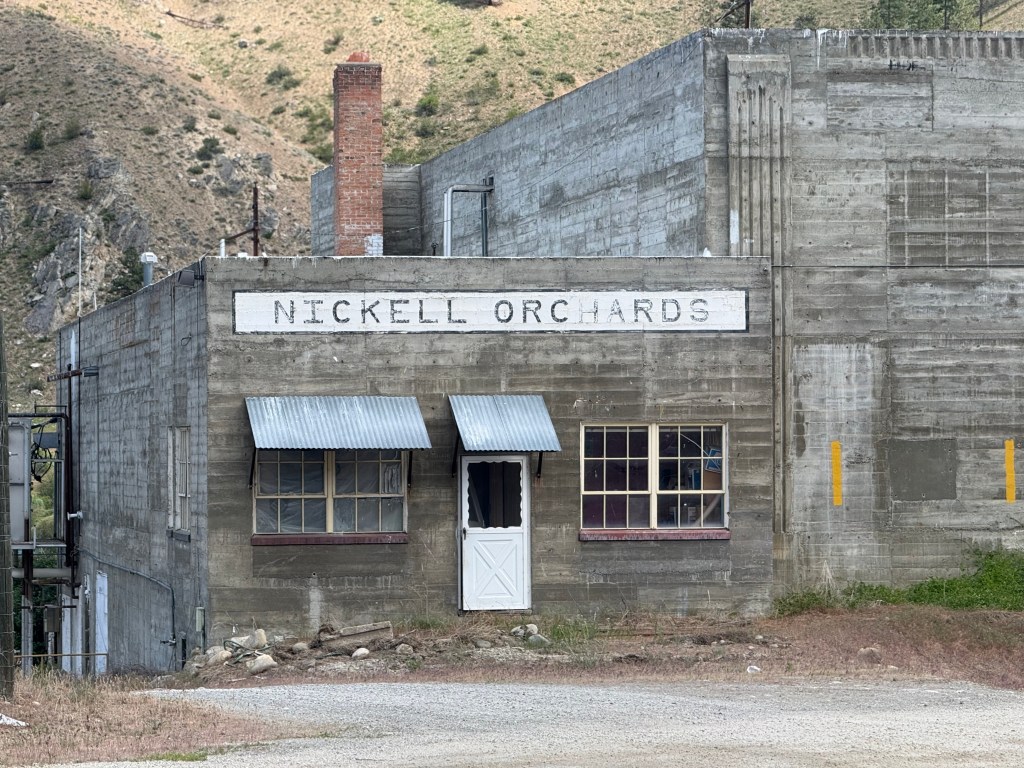
Harvey H. Nickell was born on December 27, 1857, in Callaway County, Missouri to Isaac and Isabella Nickell (History of North Washington 1904). When Harvey was just shy of 10 years old, his brother George E. Nickell was born, on October 21, 1867, but this time in Cass County, Missouri. Isaac and Isabella Nickell had 13 children in total.
In 1872, when Harvey was 15 and George was 5, their parents moved the family to Wise County, Texas. By 1877, Harvey married Alcenia Ray and was farming. But Harvey and Alcenia Nickell longed for the frontier and quickly decided to move north ending up first in Pendleton, Oregon, then Kittitas County, Washington, before finally settling in the Methow Valley in 1887. At this time there were no wagon roads in the Methow Valley, and it is likely that Harvey Nickell was one of the first homesteaders in the area. Alcenia and their four children arrived on July 4, 1888. Alcenia died at far too young in 1890, but not before giving birth to the first Caucasian child born in the Methow Valley – Mary Ellen Nickell.
One of Harvey and Alcenia’s sons was named David Franklin Nickell, born in 1883 in Wise County, Texas. This is a name we will return to shortly.
Harvey Nickell later married once more, but focused his remaining years on stock raising, business ventures, and civic positions and appointments throughout Okanogan County. He was at one point sheriff in Okanogan County and ran a mail stage between Brewster and Conconully. In one memory recorded in 1904, Harvey reminisced that he and his brother George counted 1,000 deer in a single drove while out hunting during their earliest years pioneering the Methow Valley. Harvey died at age 66 in 1924.
George Nickell – while being slightly younger than Harvey – after attending school in Wise County, Texas, also decided to join his brother and family in the Methow Valley in 1888. George and Sally Barnett had married just one year prior in 1887 in Texas. George was just 21 years old when moving with his family north.
George and Sally eventually had seven children, named Robert Newton, Benjamin, Walter, Carl, Kathryn (“Katie”), Mable and Stanley. Their family lived on a farm and orchard just south of Twisp. A 1904 record indicated that the George had 160 acres of alfalfa and an orchard with 200, “well selected and choice trees,” and that, “Mr. Nickell devotes himself to general farming and raising stock.”
Katie (Nickell) Mattison remembered many years later that George’s orchard was one of the first in Twisp (2). She recalled eating the first apples from those trees, and that her dad had originally brought the trees – as a stack of little saplings lashed to his saddle – by horseback from the Okanogan Valley. The types of apples that Katie remembered her dad growing included “old-fashioned types”, such as Ben Davis and Northern Spy (see Section 2. Apple Varieties for more details). Katie also fondly noted that “snow apples were the best,” and that she could, “still taste them.”
George Nickell was also involved in public and civic affairs throughout the Methow Valley and Okanogan County during his later years but died at age 69 in 1937.
The brothers, Harvey and George Nickell along with their families, were both pioneers in the Methow Valley and Okanogan County in general. While Harvey focused on various business ventures throughout his life, George focused on farming and orcharding. As mentioned earlier, one of Harvey’s sons was named David Franklin Nickell. Similar to his father, David focused his life’s work on civic affairs, owned a grocery store, and a fruit orchard. He married Jacqauelyn Fulton in Twisp in 1909, but they moved sporadically including to Denver, Colorado, Shoshoni, Wyoming, then Wenatchee, then finally to Pateros in 1928. David was a preacher at the Pateros Church of Christ for many years. He died when he was 79 years old, in 1963.
David and Jacqauelyn Nickell had four children, including David Leland “Lee” Nickell and Jack F. Nickell, both of Pateros.
The older brother, David Leland “Lee” Nickell, was born on May 27, 1922, while the family lived in Denver, Colorado. The younger brother, Jack F. Nickell, was born on August 22, 1924, while the family lived in Shoshoni, Wyoming. Growing up in Pateros after 1928, Lee and Jack were surrounded by two things: a large and extend family throughout the Methow Valley, and fruit orchards, specifically apple orchards.
It should thus come as no surprise that after serving honorably throughout Europe and the Pacific during World War Two, both Lee and Jack returned home to Pateros and began working in the apple industry.
Although the exact date is somewhat unknown, shortly after returning home from the war Lee and Jack began their orchard company and apple packing warehouse under the brand name “Nickell Brothers”. Nickell Brothers was well-known throughout Pateros and had warehouse space located immediately downtown along the railroad tracks. Their orchards were located on the bluffs overlooking Pateros and up the Methow River Valley.
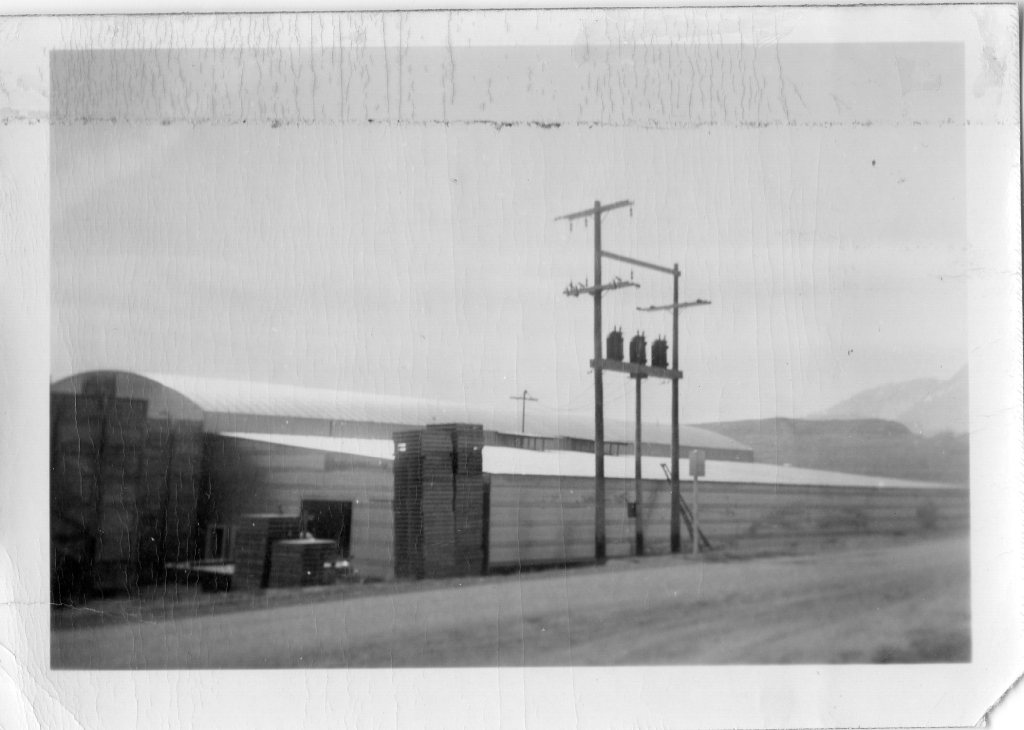
Both Lee and Jack were avid gardeners, outdoorsman, and were active in the community. At one point Jack Nickell was a Pateros school board member and the mayor of Pateros. But, as their business grew, so did the town of Pateros, and Nickell Brothers experienced the same fate as so many of the packing warehouses and storage facilities in downtown Pateros after the construction of Wells Dam – they were destroyed and forced to rebuild.
Correspondence and records in the Great Northern Railroad archives indicate that in 1959 negotiations were underway for construction and lease of a new warehouse space in downtown Pateros for Nickell Brothers orchards which would handle ~100 cars of apples per year. The lease was originally for 15 years with a renewal option for up to 10 additional years.
However, by 1966-1967 Lee and Jack decided to end Nickell Brothers and the business transitioned to “Nickell Orchards” managed solely by Jack and his wife and partner Zella Mae Nickell (see Figure below). Correspondence from 1967 indicates that Jack and Zella entered into a lease under the same terms and space with the Great Northern Railroad. Jack and Zella’s daughter, Donna, and their son-in-law, Kent Moore, helped recently confirm that in the late 1960s the orchard business did indeed become Nickell Orchards and while Jack and Zella had additional partners over the years, they remained the sole owners.
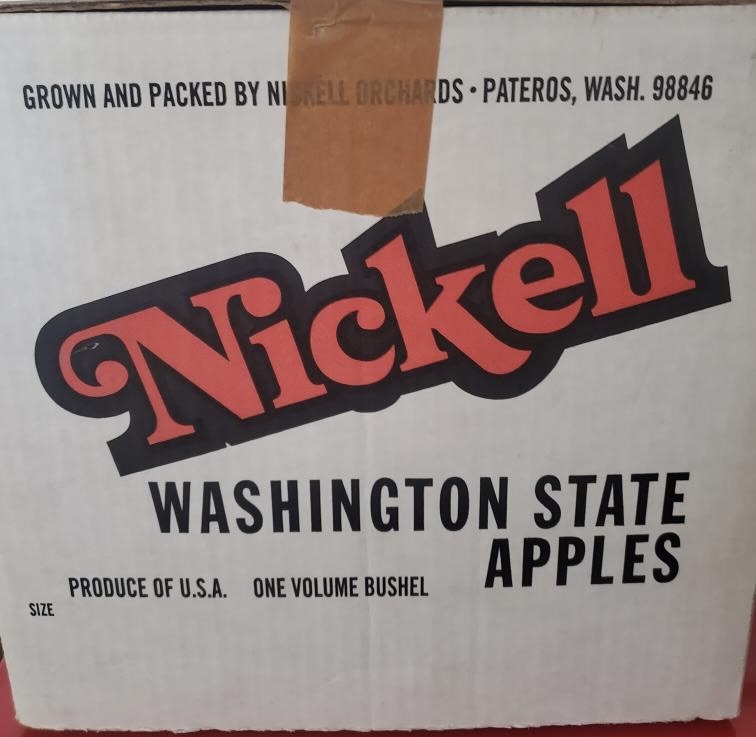
In a beautifully illustrated book titled “Washington Apple County” published in 1995 with photographs by John Marshall and essays by Rick Steigmeyer, there is a gorgeous photo tucked away on page 50 of a Fuji apple glistening in the sun. That apple was photographed at the “Nickell Orchards” in Pateros, which are shown on a full-page spread just a few pages later (see two photographs below).

And while Nickell Brothers only packed apples in their downtown Pateros warehouse, Jack and Zella later purchased an atmospheric cold storage warehouse just south of the town of Methow for Nickell Orchards. This warehouse was originally built and constructed for the Bolinger orchards, then Gold Creek Growers, before becoming part of Nickell Orchards, and now today Gebbers Farms. Kent Moore remembered that when he began working for Nickell Orchards in 1976, their brokerage firm was Gwin, White, and Prince out of Wenatchee, Washington. Nickell Orchards later remodeled the Methow warehouse to add more controlled atmospheric storage.
Of the interesting historical records surviving from the 20th century apple industry, the May 1963 “A Survey of Apple Clones in the United States,” noted that the Nickell Brothers orchards were maintaining the “Excells Red” apple variety at their orchards in Pateros. Just one of likely many experiences and stories from the Nickell orchards over the years.
Lee and his wife and partner Elaine had four children. He passed away in 2009. Jack and Zella Mae had seven children. Jack passed away a few years after Lee, in 2013. These two brothers, descended from David Nickell, and prior to that Harvey Nickell and his brother George Nickell – two of the earliest homesteading families in the valley – continued the long-tradition of Nickell family brothers living, working, and orcharding throughout Pateros and the Methow Valley.
Smith
Around 1909 Roy R. Smith moved from Spokane to Brewster and got into the apple growing and orcharding business. His brother, Horace E. Smith, was a former Washington State Senator (similar to W.A. Bolinger) and eventually moved to Okanogan County in 1913 to join his brother and work as an engineer. While Horace E. Smith did not directly join his brother’s apple growing operation, his sons – Horace W. Smith and Roger S. Smith – eventually did in the early 1950s when they took over the family business.
There are few records pertaining to Roy Smith’s orchards, but those available help highlight the trajectory of his orcharding career. On September 22nd and 24th, 1952 two local newspaper articles in the Spokane Chronicle reported that Roy Smith purchased and began operating the ~100-acre R.A. Downing orchard approximately four miles north of the town of Bridgeport (on the south side of the Columbia River). Several acres of the orchard had been recently cut down to create a townsite named Downing – likely to honor R.A. Downing who died one year prior in 1951 (see above). This was Roy Smith’s second orchard operation – his first was located two miles west of Brewster – and while his new orchards were located near Bridgeport, he still hauled his apple crop to Pateros for packing and distribution. Smith had purchased a packing shed and dehydrator in downtown Pateros in ~1950 (the operation that Horace W. Smith and Roger Smith eventually took over). The Spokane Chronicle reported that other orchardists located in Brewster also packed and processed fruit in Smith’s Pateros shed. In 1949 the Okanogan Independent also noted that the Beebe Packing House and Cold Storage Plant (and orchards) in Brewster sold. Roy Smith purchased 15 additional acres for his Brewster orchard at that time.
One surviving November 1926 photograph in the Okanogan County Historical Society records shows Roy Smith’s packing crew at his shed in Brewster.
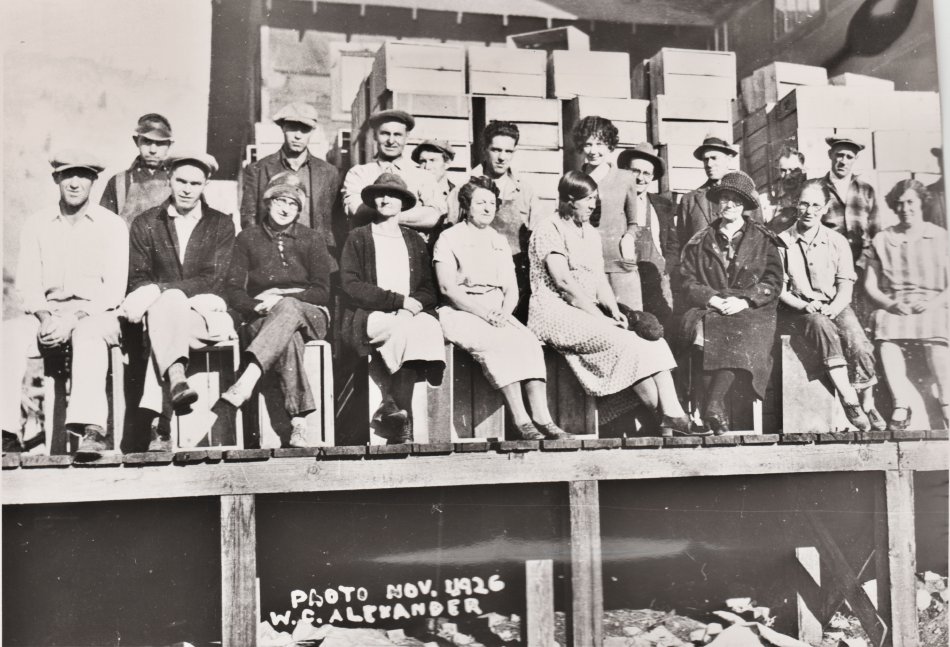
As Horace W. Smith, who with his daughter Stephanie Younie kindly answered numerous questions for me for this project (20), remembers it, in the early 1950s he, his brother, and uncle bought an out-of-business apple dehydrator warehouse in downtown Pateros to pack, store, and ship their Smith Orchards apples. Their orchards were located primarily in Brewster and near Bridgeport, but they transported boxes of apples loaded onto trucks to Pateros where they were graded, packed, and stored. Horace remembers that they grew mostly Red Delicious apples and then later Red Gravenstein (also known as Red Sport) during this time and that one of their struggles – which was common to orcharding families throughout the region – was obtaining enough labor in the fall for harvesting.

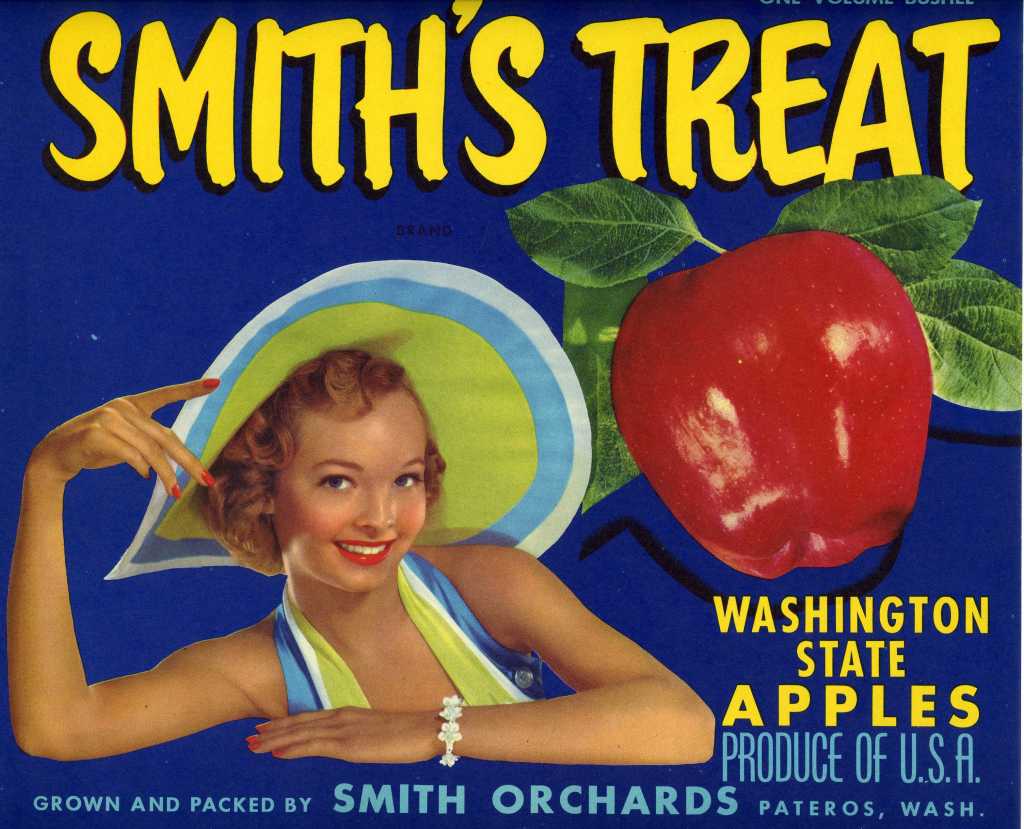
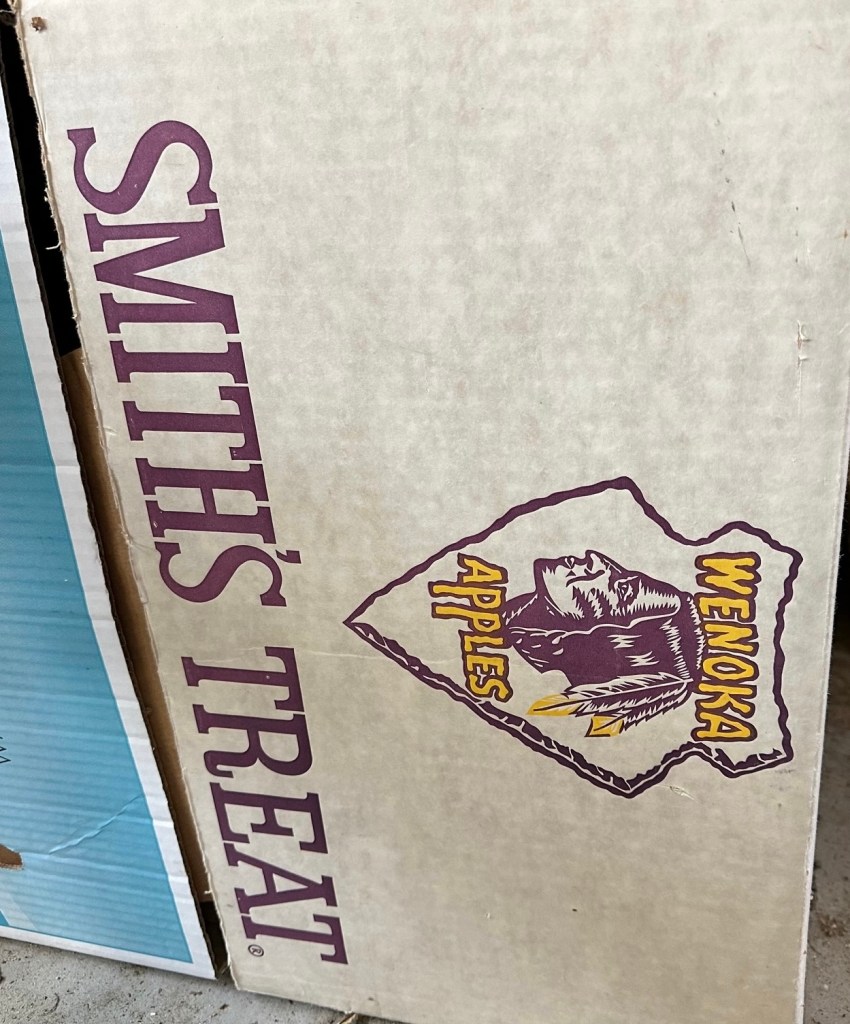
Eventually, with the construction of the Wells Dam and the forced removal of cold storage warehouses and packing facilities in downtown Pateros, Horace and his brother Roger decided to sell off their remaining orchards and warehouse and move on to different careers. The last Smith Orchards apples were likely picked and sold sometime during the late-1960s. Horace did have a separate cherry orchard after this, but the family did not resume growing apples or selling under their family brand. The Smith family sold their apples under the “Smith’s Treat” brand. This was an apple label with a blue background and yellow text angled across the front of the image. Interestingly, of the Washington state apple labels curated and digitized at the Smithsonian National Museum of American History in Washington, D.C., one label is from the Smith Orchards (#1361715). A second known Smith family apple label also used the “Smith’s Treat” text but depicted a woman lounging next to a red apple. The Smith family kindly provided a photograph of a ~1950s or 1960s era Smith’s Treat cardboard apple box as well (see below).

Starr
R.W. Starr was likely one of the oldest growers to start an orchard in Pateros when he planted the original “Tract 1” along the Columbia River, south of Pateros, in 1911. He was 66 at the time when the first trees went into the ground at Starr Ranch, but he passed away a mere 10 years later in 1921 at the age of 76. Starr’s son continued growing and expanding the ranch, but later sold it, and by 1964 it totaled 340 acres. Of the orchards in Pateros, the Starr Ranch suffered significantly – and was functionally destroyed – by the construction of the Wells Dam which flooded nearly all of the orchard forcing the Douglas County Public Utilities Department to purchase the ranch outright to mitigate the loss. Only about ~70 acres of young trees were saved and auctioned off according to the November 12, 1964 Quad City Herald.
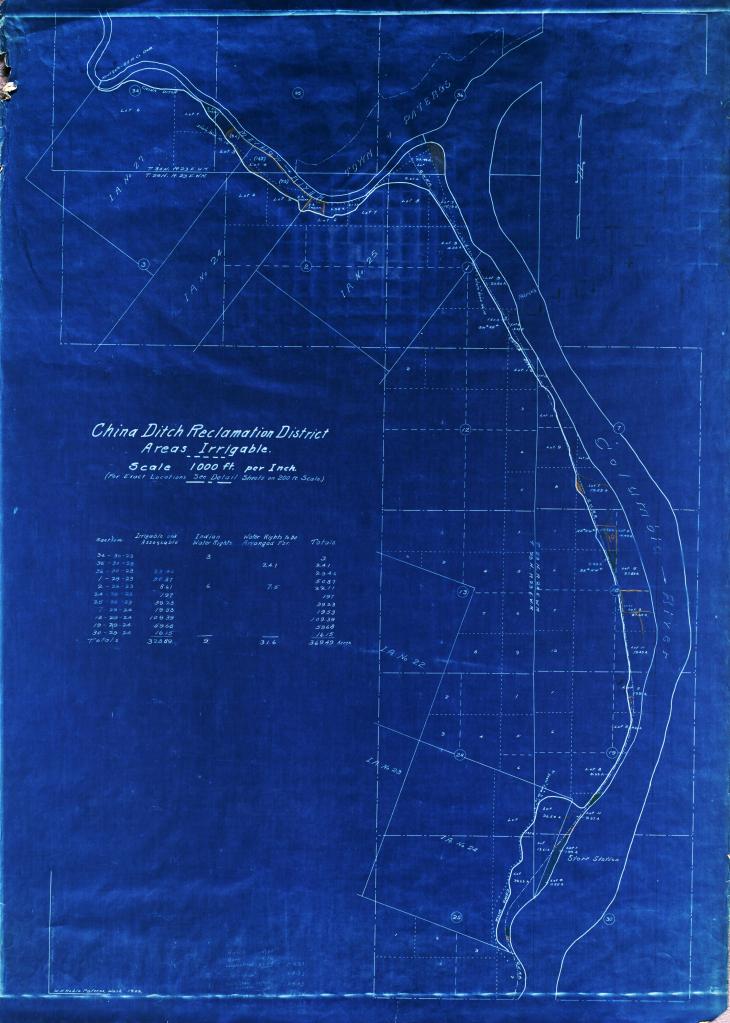
One of the interesting aspects of the Starr Ranch is that R.W. Starr bought the original “China Ditch” running along the Methow River through Pateros, down the Columbia River, which he both enlarged and extended to irrigate his orchards (23) in the early 1900s. This likely occurred shortly after he founded the ranch in 1911. A Washington State Archives historical 1922 map of the “China Ditch” through Pateros shows it ended at “Starr Station” along the Columbia River.
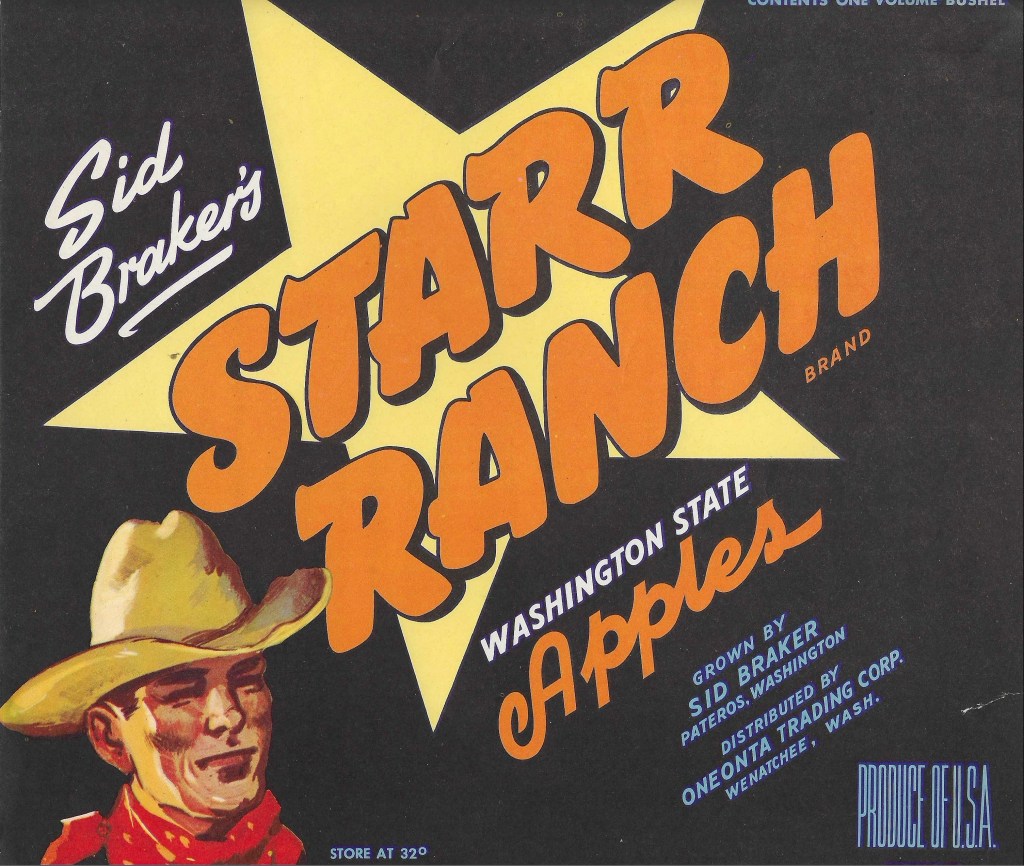
At some point during the early 1930s (perhaps 1934) local Brewster resident Sid Braker joined (or bought) the Starr Ranch and orchards. The well-known Starr Ranch apple label depicting a star with the text “Starr Ranch Brand Washington State Apples” and a cowboy figure in the lower corner stated that the apples were “grown by Sid Braker Pateros, Washington”. A known date for this apple label was 1938 (17), and prior to the sale of the orchards in the 1960s, Sid Braker was described as the owner in local newspapers. However, during this same early period, in 1934, Paul “Tommy” Thomas founded what is known today as the “Oneonta Trading Corporation”, according to their own company history (24). This history continues to note that:
“Initially, most of our fruit was grown on the original 300-acre Starr Ranch, south of Pateros on the beautiful Columbia River. But in the 1960s, the orchard was flooded with the construction of Wells Dam. Tommy and his fellow partners bought two more 100-acre ranches near Brewster and constructed the first packing plant, which still lives on as one of Starr Ranch Growers’ warehouses today.”
Tommy and Sid became partners after deciding to join the Oneonta Trading Corporation and Sid’s “Custom Apple Packers” company and they specifically sold apples under the Starr Ranch label, ultimately leading to the modern association called “Starr Ranch Growers”.
As the Quad City Herald reported in November 1964, the final packing at the Starr Ranch and orchards numbered approximately 100,000 boxes of apples.
Numerous Others
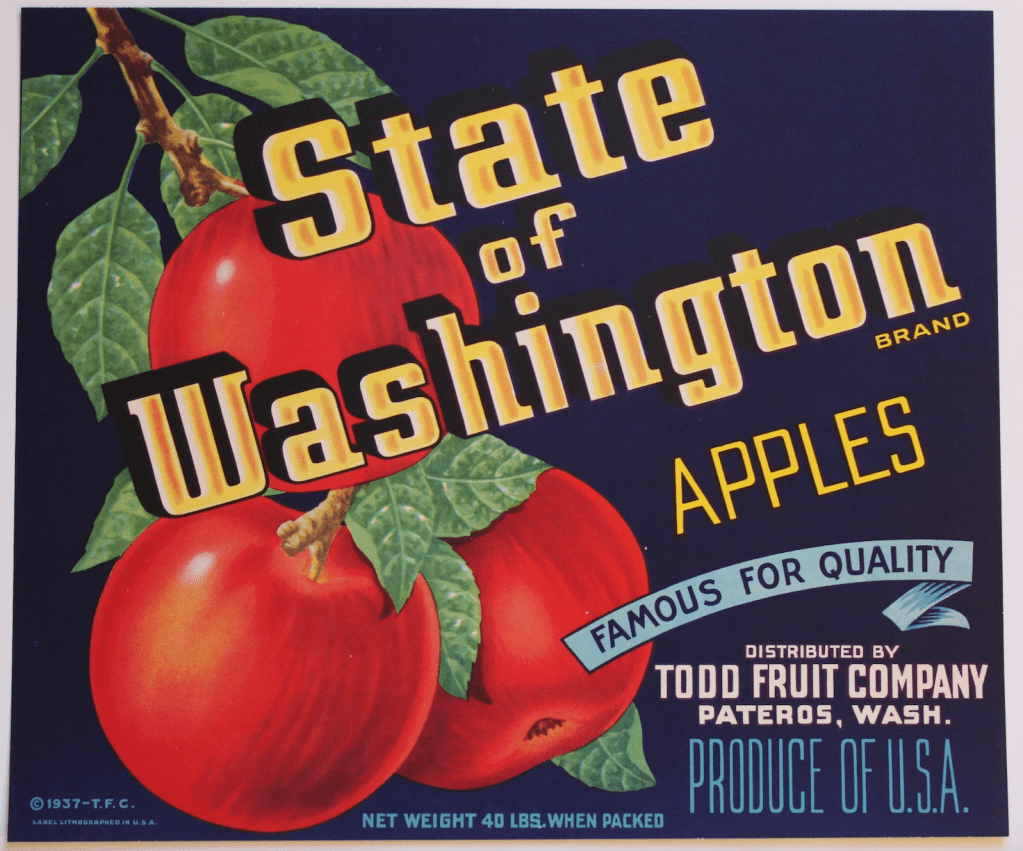
While the growers and apple brands described above hopefully include a good portion of the well-known orchardists throughout Pateros and the Methow Valley in the early- and mid-20th century, it certainly does not include all. There are several known growers and labels that have historical records which are incomplete – or perhaps better put, historical records which I have not successfully found, yet! Take for example the “Buck Fruit Company” who packed and shipped apples from Pateros under the “Pride of the West” label which is associated with one date of 1923 (17). Or, for example, the “Todd Fruit Company” which has a known connection to Omak, but also apparently packed and shipped apples from Pateros. A November 14, 1940, Quad City Herald article wrote:
“The Todd Fruit Co. ended its packing season at Pateros this week with a total packout of 83,000 boxes. Manager M.S. Todd reported that the plant showed a considerable increase over last year and that the crop was one of the cleanest in many years. Mr. Todd stated that this was remarkable as most orchards throughout the district had more worms and cull loss than usual. The report stated that the packed fruit is in excellent condition with Delicious firm now with no decay.”
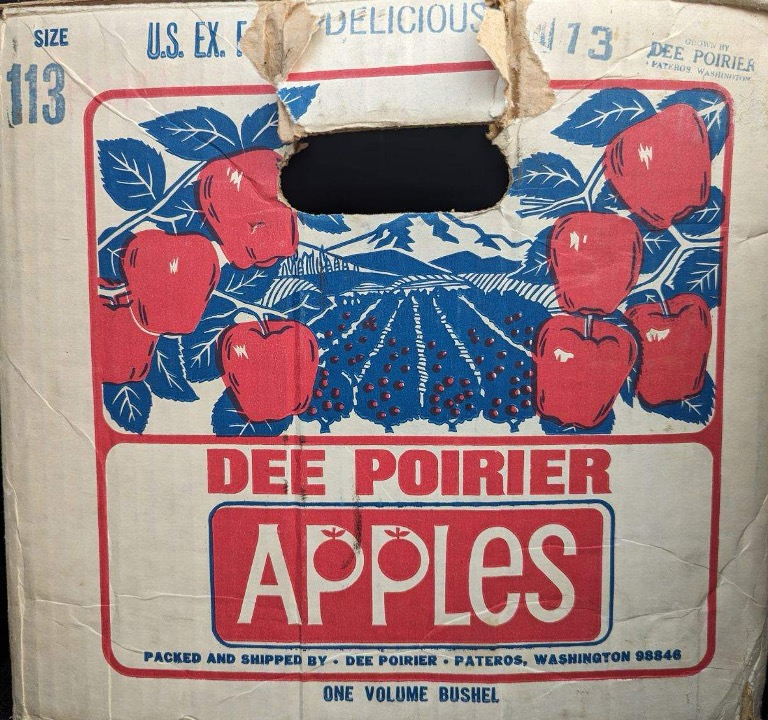
There is also the well-known “Twisp River” apple label from the Child and Thompson families out of Carlton, and although I have not documented a detailed record for these families, I am certain it exists and suspect it likely matches a similar type of growing, packing, and selling relationship as Larrabee and Neff, or Starr. Then there are growers who arrived in Pateros and the Methow Valley during the mid- to late-20th century and sold under their own brands using, by that time, cardboard apple boxes. Dee Poirier’s brand and orchards along the Methow River north of Pateros is a good example (see below). Apple brands that originally packed and shipped using wooden crates and labels also eventually adapted to cardboard boxes during this period.
And finally, the Great Northern Railroad records suggest that there were several other packers, cold storage warehouses and shippers present in downtown Pateros at least during the 1960s when negotiations occurred to reestablish and reconstruct warehouse space after the completion of Wells Dam permanently flooded downtown. These included contracts for well-known families and companies, for example: 1) Jack F. Nickell, Zella Mae Nickell, and David L. Nickell (as part of Nickell Brothers), 2) Bert S. Stennes, 3) George W. Neff, Dowane V. Neff, John E. Neff, and Amy L. Neff (as part of Larrabee and Neff Orchards), and 4) Horace W. Smith and Roger S. Smith (as part of Smith Orchards, Inc.).

If you have any suggested revisions or additions, please email: cylerc [at] gmail [dot] com
 Pateros-Methow Apple History