A Wenatchee Commercial Club information booklet for the prospective “Homeseeker and Investor Concerning the World’s Champion Apple Growing District in the Upper Columbia River Basin,”(1) from 1910 provided a lively description of the Methow Valley:
“With its scenic beauty, wonderful fertility and near-at-hand opportunities for hunting, fishing and recreation, the Methow Valley has every promise of becoming the center of many happy homes.”
The booklet continues to describe that while the Methow Valley was originally settled by “stockmen”, it was ripe for horticulture, particularly for apple orchards. Only a few orchards were producing sizeable quantities of fruit at this point in 1910, but the apples were noted to “acquire a perfection and glow here that are hard to beat.” It is difficult to imagine a more accurate sentiment!
But for these early orchardists, depending on who you ask, there were several ‘firsts’ for who planted the earliest apples in the Valley. By the 1880s newly arrived settlers and homesteaders began farming and ranching, and multiple families planted apple trees. Records confirm that by at least 1888 Jim Robinson planted around 200 fruit trees and began irrigating his orchard directly across from the town of Methow, but within two years, in 1890, Johnnie Faihst planted a 50-tree orchard of various varieties in the Methow Valley (2-3). Faihst claimed to be the ‘first’.
Within several years after arriving in 1892, the Stennes family also began growing apples along the bank of the Methow River north of Pateros (4). Another early orchardist was Peter Averill and his family (2). Arriving sometime in the first few years of the 1900s, Averill planted numerous apple varieties in his orchards near the town of Methow. The Jess family arrived in 1905, moving from Wisconsin, and homesteaded several miles up the Methow River from Pateros and began planting apples in the 1910s.
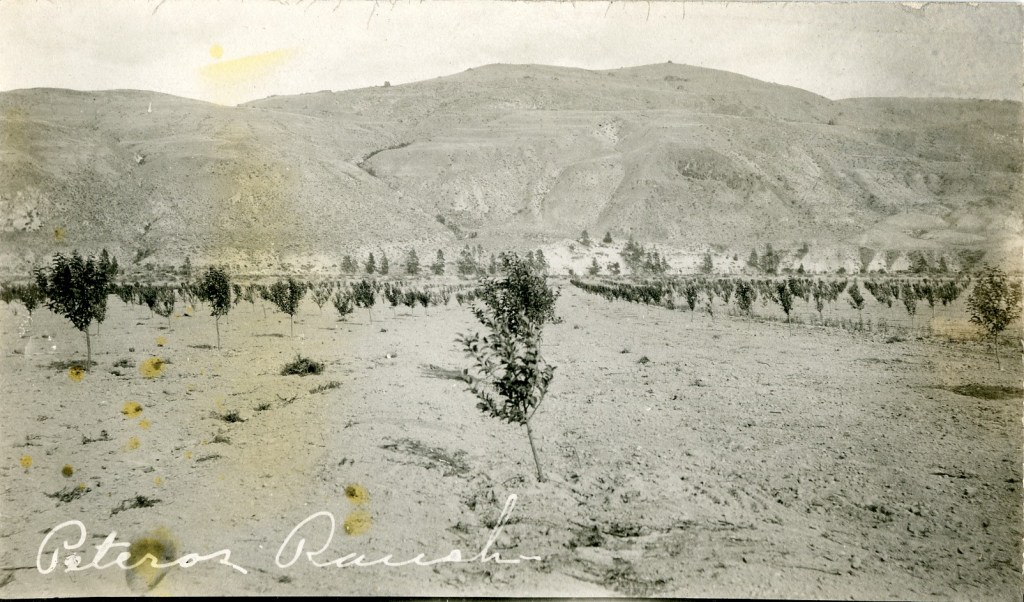
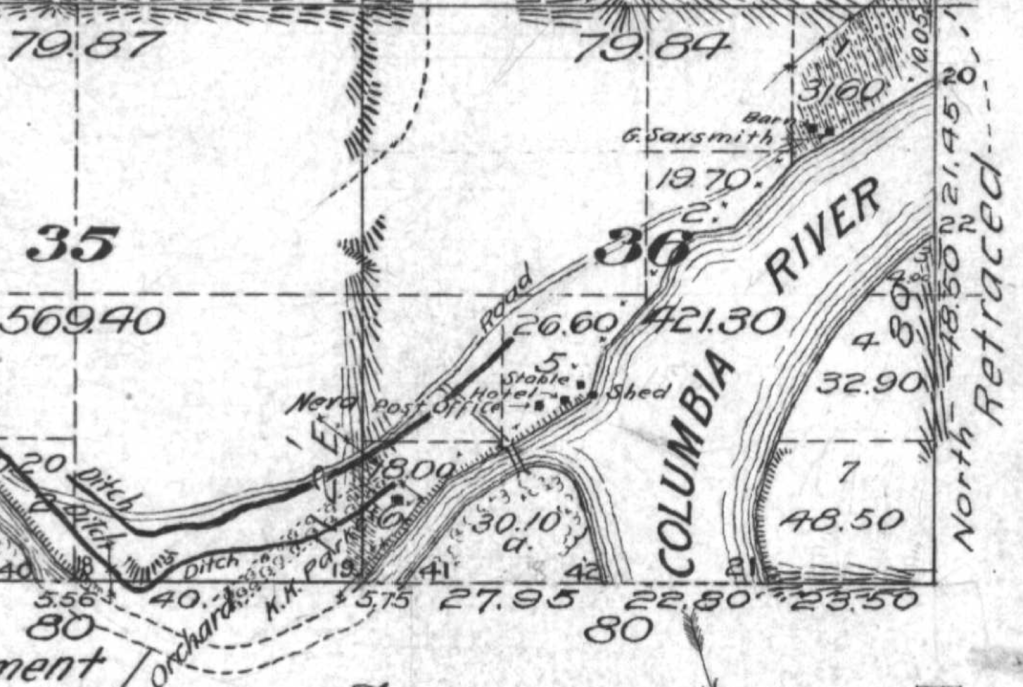
Further north in the Valley, Guy Waring bought a tract of land known as “Land 5”, located northwest of Winthrop, in 1904. Waring planted winter apples, as part of the Methow Trading Company, on 22 acres of “Land 5” later that year (3). When lifelong Methow Valley resident Vi Lemons was interviewed in 2009, she remembered that her grandfather, Bill Peckham, claimed to have planted one of the first apple orchards in Pateros during the spring of 1909 (5). Their family orchards extended from near the original ferry landing along the Columbia River up the hillside. But, an 1896 Cadastal Survey Map of then “Ives Landing” (the town became Pateros in 1900), suggests that several orchards were already planted and growing along the banks of the Methow River and Columbia River at the location of Ives Landing by the mid-1890s. One of these orchards was owned by Knight K. Parker who homesteaded along the Methow River around 1889 and built an irrigation ditch to support his orchards (visible along the east side of the river in the map below). The famous “China Ditch” was already present along the west bank of the Methow river when Parker constructed his own.
In a letter to the Methow Valley News on June 12, 1906, Parker – writing about apple fruit culture – noted, “We would like to state that we feel that the Methow Valley should become one vast apple orchard, and the farmers need to look well to the strains of fruits selected.” This sentiment was certainly shared throughout north-central Washington. The Wenatchee Daily World wrote on July 30, 1910, that what the Methow Valley really needed was a railroad and, “fruit growers and capital to develop their rich fruit lands”. Of course, the article ended by noting that Wenatchee could provide the “capital” needed and that, “Methow and Okanogan need and now have the friendship of Wenatchee.”
Apples already being grown in Pateros helped support this push for expansion. For example, on September 18, 1903, the Methow Valley News reported that W.Z. Cooper, “who owns a ranch at the mouth of the Methow on the Columbia River,” sent several large Wolfe River apples to the news agency. The paper added that, “Two of the apples in our front window [in Twisp] have caused many to stop and admire them.” In 1903 the Pateros town history noted that a W.R. Pasley won prizes at the Spokane Interstate Fair and the Idaho State Fair in Lewiston for his apples grown in town (6) – the The Spokane Press newspaper from October 9, 1903, confirms Pasley’s win in the “plate apple display”, but spelled the town “Pataso” (this last point is prescient to anyone from Pateros listening to the Spokane news mispronouncing Pateros during the annual State B Basketball tournament!). Another early Pateros resident, G.M. Adams, was growing and selling apples from his orchards two miles northeast of town along the Columbia River by 1904 (7).
These patterns continued during the early 1900s as numerous additional families arrived in Pateros and the Methow Valley and began planting. George Crane planted orchards in 1909 across the Columbia River from Pateros and also in the town of Brewster, just to the northeast, by 1912 (8-9). The beginning of the Gebbers orchards in Brewster also began during this time when Dan Gamble planted his first apple trees in 1910, followed by a packing shed in 1918 (10). Bolinger, Larrabee, Neff, Brownlee, Jess, Steiner, Starr, Glover, Malcolm Murray, Rose, Otto, Kinder, Laurgaard, and Nicholl are all Pateros families that homesteaded began their orchards along the Methow River during this period as well (11) – but this list is certainly not exhaustive. Nearly all homesteading and settler families that arrived during this period began planting and growing apples and other fruit throughout Pateros and the Methow Valley during the late-19th and early-20th centuries.
Pateros and the Methow Valley have experienced many trials since the late-1800s. The cold and deep snows of the winter of 1889-1890 which killed large numbers of cattle, the winter freeze of 1920 which killed entire apple orchards, the infamous Methow and Columbia River flooding and destruction of late spring 1948, the inundation and destruction of the original town after the completion of Wells Dam in 1966-1967 and almost immediately afterwards, the deep winter freeze that destroyed whole orchards throughout the Valley in 1968. But, of all the events which shaped the history of the apple industry in Pateros, one of the most significant was the arrival of the railroad.
In 1914, the Great Northern Railroad arrived in Pateros after being constructed north from Wenatchee and south from Oroville. The Pateros town history described that the arrival of the railroad caused much “fan fair” in town (6), and it ultimately forever changed the fruit industry in north-central Washington. Now, instead of transporting boxed apples by horse and wagon, or stern-wheelers along the Columbia River, apples could be packed and shipped by rail throughout the United States. According to at least one account in 1914 the “first railroad car of commercial apples” was shipped from Pateros to Boston (3), and “[o]f the 350 boxes sent” from throughout the Valley, 299 came from Waring’s Land 5 orchard in Winthrop.
If you have any suggested revisions or additions, please email: cylerc [at] gmail [dot] com
 Pateros-Methow Apple History